
A striking lack of coverage by Western journalism does not conceal the disturbing reality that since January 2023, the nation of Haiti possesses no legitimate government and is being socially and constitutionally decimated by violent gang rule, with calls for intervention being met with a sluggish response by the UN. In this piece, Lucy Holmes shines a light on how Haiti has found itself under the thumb of over 200 armed gangs, devoid of any form of elected representation, and once again facing the apathy of the international order.
Long-term instability
Haiti is widely known as the poorest country in the Western hemisphere, and has struggled notoriously against its colonial legacy; oppression, reparations, and insecurity have plagued her development as an independent nation, not to mention the omnipresence of natural disaster. Despite this, there has been some democratic progression since downfall of the tyrannical Duvalier dynasty in 1986, though not without considerable difficulty. The coup d’état of February 2004, which ousted Haiti’s first democratically elected President Jean-Bertrand Aristide from office, required resolution via UN intervention. The installation of a peacekeeping mission (MINUSTAH) was present until 2017, tasked with preserving democratic rule and civilian safety in the wake of the coup, and the later infamously catastrophic earthquake of January 2010. The magnitude 7.1 disaster caused widespread mass destruction due to poorly constructed and regulated civilian infrastructure, intensifying the death toll to almost a quarter of a million people. Since October of that same year, cholera has re-emerged as an endemic disease, continuing to infect and kill Haitians at the time of writing. The loss of democratic governance in the face of natural disasters, the 2022 global energy crisis, poverty, acute hunger, poor living conditions, and human rights abuses have precipitated the ideal environment for gang rule to replace organised government – a chain reaction sparked by the brutal assassination of President Jovenel Moïse on the 7th July 2021 by Colombian mercenaries, allegedly hired to effect regime change in the country.
Political collapse
To understand Haiti’s current political climate, we must turn the clock back seven years. On 20th November 2016, Jovenel Moïse, representative of the Tèt Kale Party, won the Haitian presidential elections to replace interim President Jocelerme Privert. Electoral turnout was problematically low at less than 22%, but Moïse was sworn in nonetheless on 7th February 2017. Such limited representation and the question of presidential term length fed into rumbling public unrest. Haitian presidents govern for 5-year terms, and because Moïse’s elected predecessor Michel Martelly had stepped down in 2016, many Haitians perceived his term to be rightfully ended in February 2021, but the new President insisted that his term should finish in February 2022, 5 years after his swearing-in. Violent anti-government protests throughout the country intensified, bubbling up out of pre-existing popular grievances regarding corruption and electoral fraud. During his term, President Moïse ruled by decree, undermining his nation’s democratic system. He refused to organise elections in 2018 and 2019, meaning that the terms for most of Haiti’s democratically elected legislators and mayors expired in January 2020, leaving a political vacuum in the Haitian Parliament. Moïse’s popularity deteriorated even further still following the unconstitutional appointment of Dr Ariel Henry as prime minister, who was never backed, nor formally ratified, by the Haitian National Assembly – for it no longer existed in a functional capacity.
Following Moïse’s assassination, Haiti’s premiership fell into the hands of Ariel Henry as de facto President, despite the former neurosurgeon holding no legitimate claim to office. Like his predecessor, Henry is deeply unpopular with the public, but unlike Moïse, he does not possess the boon of being democratically elected. As the Senate is currently empty, if Henry chose to seek legitimate backing, he is unable to be formally sworn in as President of Haiti. All attempts by Henry to establish a legitimate council to oversee a power transition are viewed again as illegitimate and widely resisted by opposition politicians. With the former Prime Minister showing few signs of wishing to leave office and rivals unwilling to bargain, the government remains in a condition of stalemate. Calls by Henry for international intervention to solve the gang blockade are seen as a veiled attempt to secure international sponsorship of an unelected regime. In January 2023, the terms of Haiti’s final ten remaining elected senators officially expired, leaving the country without any elected government officials. The Haitian Senate sits 30 members, and the lower legislative chamber sits 119, but all now remain empty. From the local to the national level, all Haitian political mandates have expired.
Gang exploitation
Just as Henry used the assassination to ascend to the office of President, outside of the National Palace, gangs quickly capitalised upon the insecure political environment to entrench themselves in the capital city and impose rule over the country’s economic infrastructure. It is estimated that around 100 gangs are currently operating in the capital itself, with two coalitions, G9 and G-Pép, vying for control – especially in hotspots such as Cité Soleil. Significant tactical operations to meet political objectives are ongoing, for example the main road connecting Port-au-Prince to the southern peninsula is consistently blocked and monitored by gang squads.
In September 2022, to protest and demand the resignation of Ariel Henry following his decision to cut fuel subsidies, which caused energy prices to double, G9 blockaded Haiti’s primary fuel terminal at Varreux by digging trenches and littering shipping containers. 10 million gallons of diesel and gasoline and over 800,00 gallons of kerosene were blocked off as a result. Most businesses and hospitals rely on diesel generators already due to unreliable electricity supplies, and gang posturing such as this threatens the backup means of power. It took police two months to act, storming the oil depot in November to clear out G9 and reinstate fuel supplies – though the gang’s leader Jimmy Cherizier, a former police officer who goes by the moniker ‘Barbecue’, announced that the termination of the blockade was ordered by his hand. It is no secret among Haitians that Barbecue’s long-term objective is the ascension to political office, by legitimate means or otherwise.
To maintain control in the immediate climate, gangs regulate the general population through fear campaigns, which are maintained in numerous ways. Kidnappings are alarmingly common but disturbingly effective. Rival gangs kidnap civilians to self-fund via ransom money from middle-class families, of values between $200 and $1million. 1,300 kidnappings and 2,100 murders were reported in 2022.
In 2023 thus far, over 2,400 people have been killed by ongoing gang violence. Impoverishing the middle class decreases the threat they pose as intelligentsia, and potential future political opponents. By targeting middle-class business owners through kidnappings and ‘protection’ rackets, many businesses have either been destroyed or closed down as owners try to protect themselves and their families. Street vendors are robbed or elsewise intimidated for money. Looting is not confined to Haitian businesses, although homes and businesses are being destroyed; relief supplies are also being intercepted by gangs. Most horrifyingly of all, street and gang rapes are omnipresent. Rapes have been reported in women of all ages, from the elderly to girls as young as 10 years old.
The population is also being controlled by food, water and healthcare denial – an ever more pertinent issue considering that Haiti is currently suffering a widespread cholera epidemic, made worse by a 7.2 magnitude earthquake which struck in August 2021, causing over 2,200 deaths and leaving around 650,000 people in need of humanitarian assistance. As a result of these mounting threats to life, it will come as no surprise that residents of Port-au-Prince are fleeing the capital in droves; August saw over 5000 people flee the Carrefour-Feuilles district alone in direct response to the accelerating seizure of regional control by gangs.
Next steps?
Solving the overwhelming issue on the ground in Haiti is not so simple as a military crackdown. Gangs are often better armed than the police, wielding assault rifles and machine guns sourced from corrupt police officers or smuggled from the American black market off the Florida coast. Furthermore, corruption is rooted deeper than simple bribery; many politicians and police officers are paid off by gangs in order to maintain disorder and political violence, with the subsidiary goal of exposing state inadequacies to the Haitian public. No real state authority exists over those who break the law; if arrests of gang members are made, then they are quickly released after a call to their benefactors. Thus, the deadly cycle of growing gang control persists, and feeds into the deadly cycle of why self-resolution is a nigh-impossible road for Haiti.
Acting President Henry has recently agreed to organise transparent, representative elections this year, so that a new Haitian government can be formed in early 2024. However, Henry’s assurances are of little comfort to the nation’s population, and to the international community. Similar pledges made in 2021 did not come to fruition, and he has not yet set a date for when such promised votes will occur. Even if Henry were to make good on his promises for re-instating democratic representation, it is folly to suggest that this would place Haiti on the road to repair. The lack of any popular support for the sitting government, paired with the state’s current gruesome security situation means that hosting elections at this stage is unlikely to render any positive effect whatsoever; more likely is maintaining a continued deterioration into widespread desolation.
International intervention is the path most travelled by Haitian politicians in times of emergency. However, in the context of the nation’s most current troubles, it is not a straightforward request. Ariel Henry has been calling for foreign assistance since October 2022 to reinforce the Haitian Police in their bid to regain civil authority, but such requests have been met with notable reluctance, for good reason. To do so would be to legitimise Henry’s claim to authority, when no such legal or constitutional basis exists.
Some intervention measures have been discussed by American President Joe Biden and Canadian Prime Minister Justin Trudeau respectively, but the former has shown a disinclination to be involved in Haiti’s domestic politics. Trudeau also voiced reluctance at the recent UN General Assembly, stating that ‘there is no solution from the outside’ to Haiti’s troubles, despite in February deploying fully staffed Kingston-class Maritime Coastal Defence Vessels, HMCSs Glace Bay and Moncton, to Haiti from their previous posts in West Africa to conduct intelligence patrols in the waters around Port-au-Prince.
In response to the West’s overt hesitance to act, Kenya is currently leading the charge towards securing stability for Haiti, with President William Ruto urging the UNSC to back a mission in support of a country which ‘deserves better from the world’.
In 2022, the UN finally responded to the deteriorating security situation by issuing a new package of sanctions, some bilateral, upon those individuals who support criminal activities and armed group violence in the country. Unfortunately, despite this embargo on the sale of guns and ammunition to non-state groups in Haiti, the smuggling of illegal weaponry out of the American south-east coast has only intensified. The UN is also appealing for $719 million to assist the country as part of the 2023 Humanitarian Response Plan for Haiti to target the spread of cholera, human rights violations and closure of schools, but no amount of foreign aid will rectify Haiti’s situation until the underlying causes of insecurity are resolved.
Some progress has very recently been made on the international stage, with the UNSC voting on a US-drafted resolution supporting multilateral police deployment. Whilst this seems like a step in the right direction, this news will come as little solace to Haitians whose day-to-day life currently consists of murder, hunger, kidnapping, and rape. Indubitably, debates surrounding the efficacy of foreign intervention shall hold up the process of alleviating the troubles of a nation which is crying out for solace today.
Suggested books for in-depth reading on this topic:
- Haiti: The Aftershocks of History (Laurent Dubois)
- Black Crown: Henry Christophe, the Haitian Revolution and the Caribbean’s Forgotten Kingdom (Paul Clammer)
- Zombie Files: Gangs, Drugs, Politics and Voodoo under the Mandate of the United Nations (Max Krail)
- Street Sovereigns: Young Men and the Makeshift State in Urban Haiti (Chelsey L. Kivland)
- The Complexity of Modern Asymmetric Warfare (International and Security Affairs Series) (Volume 8) (Max G. Manwaring)
You may also like to listen to our podcast with kidnapping historian and author Philip Jett and kidnap and ransom expert Scott Stewart.
Additional geopolitical reading suggestions can be found on our 2023 reading list
Purchases made using the links in this article earn referrals for Encyclopedia Geopolitica. As an independent publication, our writers are volunteers from within the professional geopolitical intelligence community, and referrals like this support future articles. You can also support Encyclopedia Geopolitica on Patreon, where you can get access to special perks while helping to contribute to the running costs of the site!
Lucy Holmes is an International Relations graduate of the University of Hull and current Master’s student in Strategic Studies at the University of St Andrews, with focus areas including European colonisation and decolonisation, Native American history, and the uses and abuses of hard power. Lucy also holds strong personal and academic interests in French history and culture, fortified by her study abroad period spent living in Bordeaux.
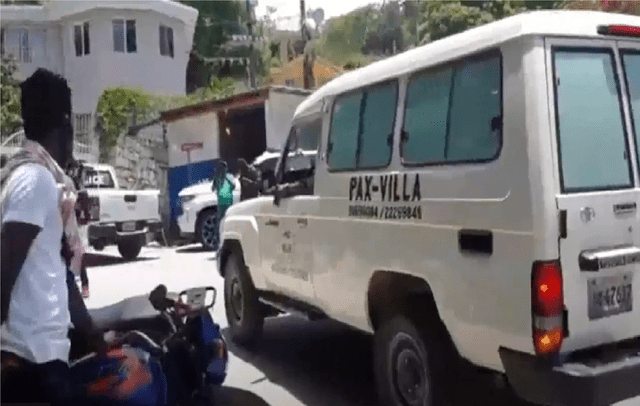
Photo: Transfer of the body of Jovenel Moïse, President of Haiti, Leve Kanpe Pou Haiti, Wikimedia Commons image
 Encyclopedia Geopolitica

1 comment
Comments are closed.