
Just under a month into the new Trump administration, global impacts from the realignment of US priorities and power are already causing shockwaves for multinational businesses. For corporate security and resilience teams charged with protecting the people and assets of these global multinationals, early indicators are emerging about the new security environment they now must operate in. In this piece, Colin Reed examines steps corporate security and intelligence teams should take to prepare.
An assessment of the early characteristics of the Trump era reveals some critical points that corporate security teams must take seriously in order to best posture themselves to fulfil their obligations to protect. Among these, the most immediate risks are those of spiking terrorism and global conflict; in the medium and longer term, reputational risk and worsening organized crime, to include cybercrime and foreign espionage, as US law enforcement and intelligence agencies are politicized and degraded. While the most drastic elements of this analysis may not come to pass, or may take time to manifest, early preparation is the hallmark of effective security and resilience teams.
A more unstable & violent world
Trump’s dismantling of USAID deprives global trouble spots of stabilizing cash flows at a time when global insecurity and climate change are driving increased need. USAID funding supports diverse programs, and, far from offering simple handouts, frequently supports the US’s hard security objectives globally. The interruption of aid, even if it is eventually resumed in some other form, either due to a legal injunction, Congressional action, or the restructuring of aid programs under the US Department of State, is very likely to have lasting security impacts globally. Security teams should closely monitor reports that loss of funding has caused security guards to walk away from prisons holding former Islamic State fighters, and that pandemic-and-famine monitoring networks are offline, potentially posing medium-and-long-term risks of mass death, conflict, and mass migration.
Degraded effectiveness of US security responses globally
Trump’s attempts to purge US security services of perceived political enemies is creating chaos at the FBI, CIA, NSA, and among other security agencies. Reports that his team intends to retarget these agencies against US neighbors in Canada and Mexico, and to pull resources away from combatting organized crime, terrorism and foreign nation-state threats to focus on immigration, are early indicators of how disruptive this shift will be, including in the long term. Casual observers may not be aware of how much intelligence sharing the US government routinely provides to governments and corporate security teams globally, especially on counterterrorism, economic espionage, and cybersecurity issues. The interruption of this support is very likely already driving an interruption in critical counterterrorism, cybersecurity, and counterintelligence work, and so long as Congress or legal action do not prevent such interruption or disruption from occurring, long-term damage to global intelligence sharing will likely mean an increase in successful terrorist incidents, cyberattacks, and conflict. Security teams at major multinational companies should begin questioning how they handle tips from US law enforcement and intelligence agencies, which have previously been treated as extremely reliable, but which may suffer from politicization and inaccuracy under the new administration. Service outages for open-source intelligence sharing, such as the State Department’s Overseas Security Advisory Committee, have already impacted corporate security teams which rely on these – among other sources – for country risk assessments or travel risk management work streams, and other intelligence failures in the future are likely. Teams should prepare to lose access or reduce reliance on these reporting streams.
Trump’s team is also signalling a reprioritized role for the US military, though it is not yet clear what precisely it intends to focus on, amid various stated priorities such as stopping illegal immigration at the border or deploying troops to peacekeep in Gaza. Indecision on the part of political leaders is likely to severely hamper the work of planners at the Defense Department, which will constrain the US military’s ability to respond rapidly to overseas crises. Whether these crises come in the form of war or natural disaster, US military responses have long played a dampening role on the scale and damage these events cause to local governments and populations, and the extent to which their impact spreads more globally through ripple-effects. With this role in question, security teams should anticipate an increase in global conflict, as malicious actors attempt to try their hands at revising the lines on the map, driving instability in unexpected places and throwing supply chains and physical security into doubt for many businesses.
Reputational risk in new places
Trump’s team’s effort to use tariffs against previously friendly countries, and his threats to seize control of Greenland or the Panama Canal by force, are driving a realignment of international views of the United States. For now, the leaders of these smaller, weaker countries are forced to comply with Trump’s dictates and lay low in the hopes that the moment will pass, but if Trump’s approach continues for the longer term, these countries are likely to begin regarding the United States as potentially hostile to their security and interests. This means a new swath of foreign actors will begin targeting the US for espionage, while regarding with suspicion its people and companies when they do business overseas. For many decades being a US-flagged company, or traveling on a blue passport, was regarded as a positive reputational asset in many jurisdictions; it is increasingly likely to become a black mark that invites suspicion, anti-favoritism, and harassment. Multinational companies should take steps now to evaluate how their brands and people will be affected in all global markets, not just those that Trump has so far directly threatened.
Degraded physical security in the United States
If Trump’s efforts to politicize the FBI proceed unchecked, they are likely to cause long term damage to the domestic law enforcement environment in the United States. Not only is the Bureau poised to lose thousands of experienced agents, damaging its ability to fight crime in the near term, but it appears likely that Trump will politicize its activities to prioritize his personal agenda and interests. This is likely to result in an increase in sophisticated and organized crime in the US, one that will likely manifest in increased loss to businesses in both physical and cybersecurity domains. Evidence from politicized law enforcement agencies in other countries, like India, China, and Russia, also indicates that businesses should anticipate the possibility of law enforcement raids on their corporate headquarters should they fall afoul of Trump’s political agenda. These ‘dawn raids’ are often employed merely as a harassment technique, but can escalate to include planted evidence of wrongdoing or actual arrests of senior corporate officers. Many multinational companies already employ ‘dawn raid playbooks’ for on-site leaders to safely and legally deescalate these stressful situations when they occur in countries that have a history of such activities; it would be wise for businesses operating in the US to begin considering how they would implement such plans in that country as well. Finally, political tensions are likely to give rise to protests and other acts of public disobedience, which could directly impact businesses which are regarded as linked to political activities, or those with physical exposure to urban centers; historic evidence of this kind of activity during the first Trump administration indicates corporate security teams should anticipate protests will be larger and more violent than normal for the United States.
Counterintelligence & insider threat risks to increase
A deprioritization of counterintelligence by law enforcement and intelligence agencies, combined with mass leaks of personally identifying information about government workers, will very likely reduce the effectiveness of US counterintelligence capabilities, meaning companies are likely to see an increase in effective targeting of their IP by foreign adversaries. Increased sensitivity to political censorship is likely to drive employee activism underground, with employees taking to off-platform communications mechanisms to share grievances against corporations and their leaders. This is likely to degrade security teams’ ability to monitor for serious violent threats, and could increase the severity of sudden insider threat manifestations. Historic evidence suggests that unstable individuals are frequently inspired to action by intense media coverage of social issues, and the intense political environment could give rise to an increase in politically-motivated violent actors, with those acts of violence playing out in both public areas and places of work.
Conclusion: priorities and resources
The emerging geopolitical landscape that pundits have predicted for years is no longer on the horizon – the Trump era signals it is now fully here. Corporate security teams now face a more complex and dynamic set of challenges than at any point in the history of many of our companies. The potential disruptions outlined in this analysis underscore the critical need for proactive and comprehensive security planning, before major catastrophes occur that impact our people and businesses.
Corporate security teams must recognize that our traditional postures are no longer sufficient in this rapidly evolving environment. Organizations must view security not as a cost center, but as a critical strategic investment essential to maintaining operational integrity, protecting human capital, and preserving competitive advantage. Security leaders must be prepared to advocate for substantial increases in budgetary commitments for their teams, providing them with the technological tools, training resources, and organizational mandate required to navigate this unprecedented risk environment. In an era of increasing global uncertainty, corporate security is no longer a peripheral function – it is a core strategic imperative that can determine an organization’s ability to survive and thrive in a rapidly changing world.
Suggested books for in-depth reading on this topic:
- Political Risk: How Businesses and Organizations Can Anticipate Global Insecurity (Condoleezza Rice & Amy Zegart)
- Bloc by Bloc: How to Build a Global Enterprise for the New Regional Order (Steven Weber)
- Unruly: Fighting Back when Geopolitics, Technology, and Law Upend the Rules of Business (Sean West)
- The Levelling: What’s Next After Globalization (Michael O’Sullivan)
- Goodbye Globalization: The Return of a Divided World (Elisabeth Braw)
Additional reading suggestions can be found on our 2025 geopolitical reading list.
Purchases made using the links in this article earn referrals for Encyclopedia Geopolitica. As an independent publication, our writers are volunteers from within the professional geopolitical intelligence community, and referrals like this support future articles. You can also support Encyclopedia Geopolitica and contribute to the running costs of the site on Patreon (where you can get access to special perks) or by tipping us on Ko-fi.
Colin Reed is a geopolitical risk adviser working in the US technology sector, specialising in strategic intelligence and global planning for businesses and executives. In his current role he works to identify, assess, and inform senior technology leaders on emerging topics of geopolitical & economic significance, and chairs an intra-business Geopolitical Strategy Council which works to align company posture to global events. He is a dual graduate of both Russian History and International Relations from North Carolina State University and a postgraduate in International Security from Georgetown University. Colin previously worked for the US government and engages regularly with industry groups and security professional associations on the intersectionality of multinational business and international affairs.
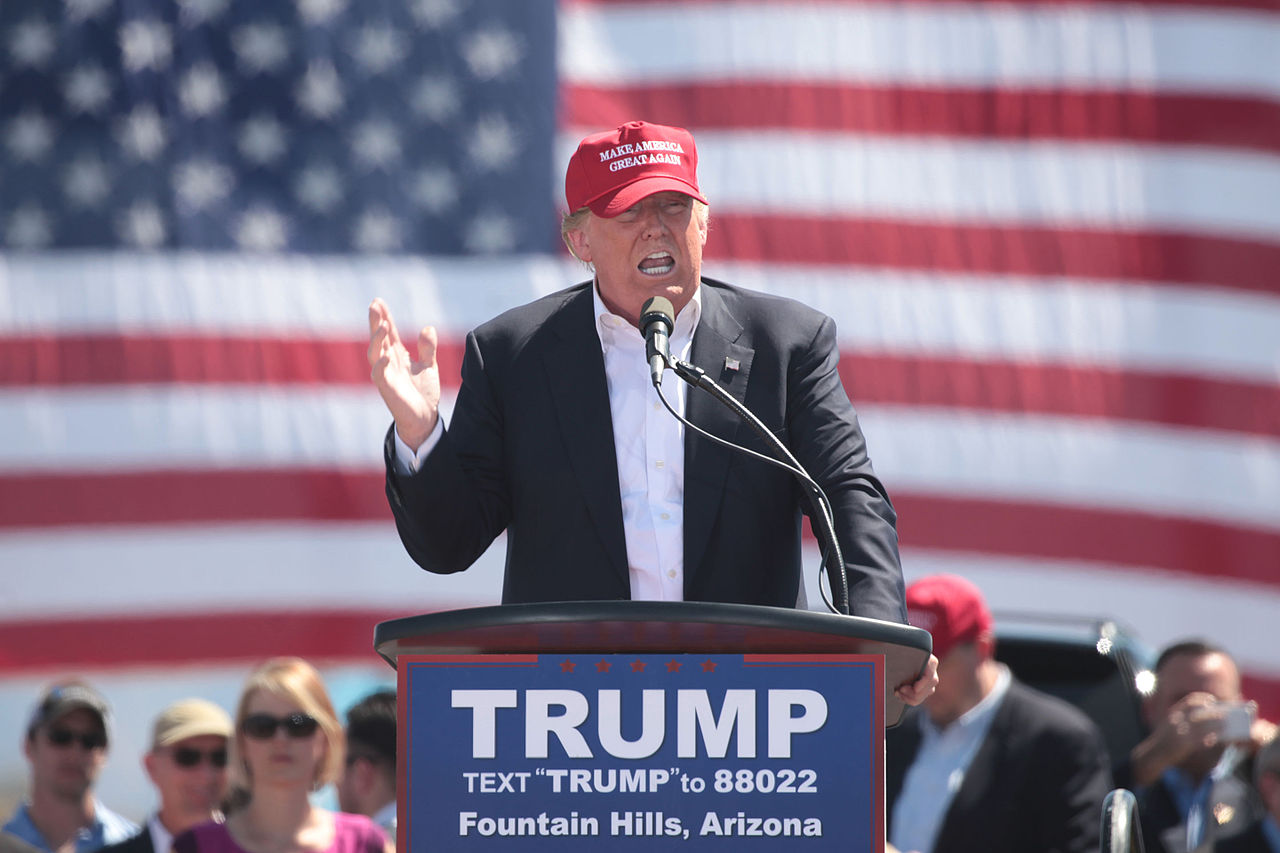
Cover image: Donald Trump speaking at a rally in Fountain Hills, Arizona, by Gage Skidmore
 Encyclopedia Geopolitica
