
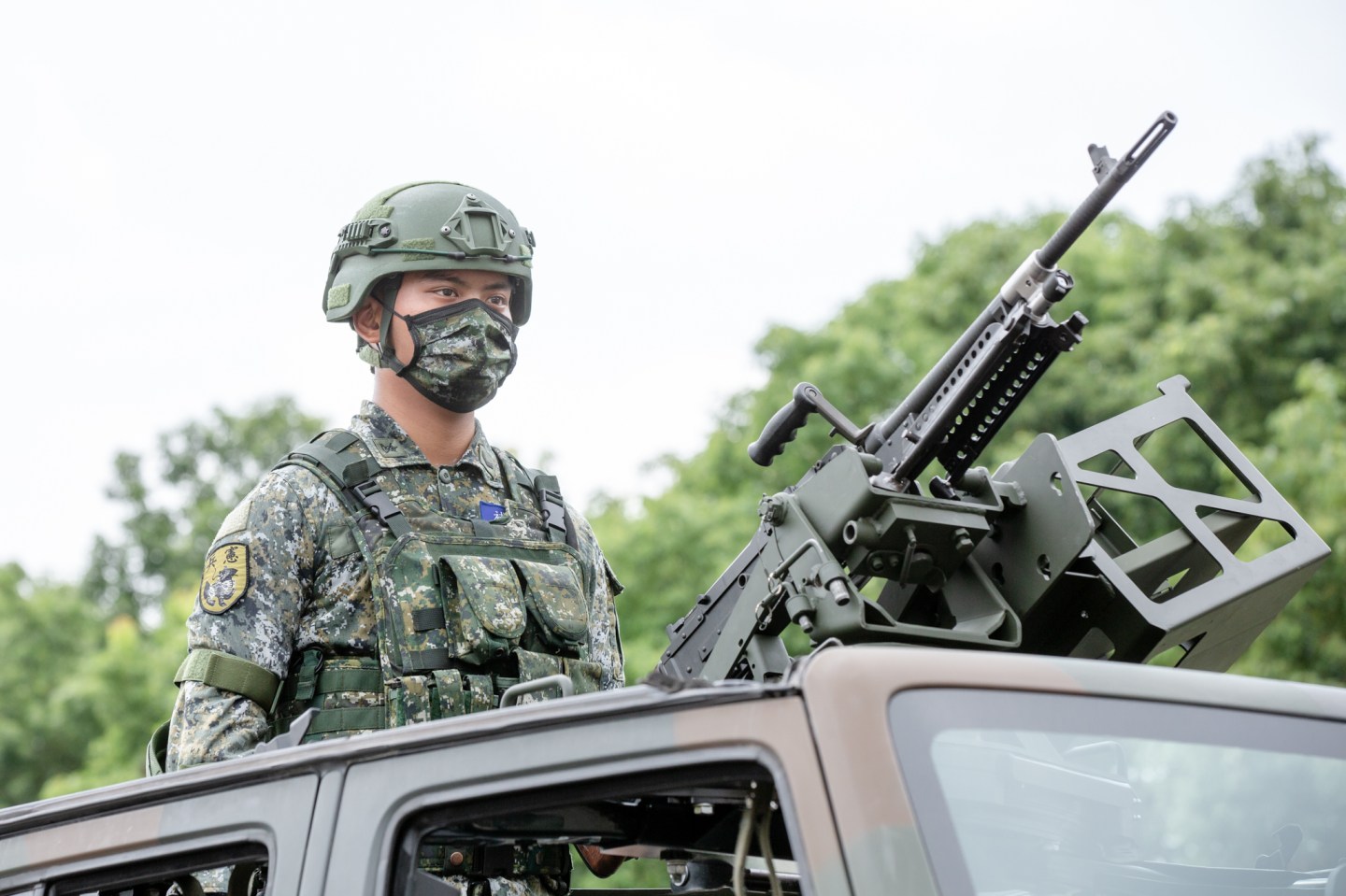
Since the Obama Administration started on its Pivot to the Pacific in 2011, defence planners and the media alike have paid an excess of attention to the creation of a cold conflict between the U.S. and the People’s Republic of China (PRC). The tension driving this conflict has typically focused on the presumption that the PRC would, at some point, challenge presumed U.S. support for a democratic Taiwan independent of mainland China, specifically via a hypothetical cross-channel Chinese invasion of Taiwan with the intent to unify the island with the mainland under Xi Jinping’s Communist Party. In this piece, Anthony Clay examines the changing dynamics of this high risk scenario.
While popular attention to a potential crisis over Taiwan has remained fairly consistent among geopolitical observers, U.S. defence planners have had to contend with shifting levels of materiel available to prepare for such a conflict over the fourteen years since the Pivot. This has in large part been due to how the U.S. military has postured itself for the numerous conflicts that have come, gone, and sometimes sustained in the interim. These “emergency” situations were rarely surprising to alert observers, but routinely interrupted the Department of Defense as it sought to reposition forces to confront China’s rise in the Pacific. Nearly all of the emergent geopolitical conflicts of recent years were disruptive to Asia-Pacific planning in some way, including the expansion and contraction of pre-existing wars in Afghanistan and Iraq, the rise of Islamic State and the Syrian Civil War, the invasion of Crimea and the later wholesale invasion of Ukraine by Russia, and recurrent fighting in Israel and Yemen. And yet, while U.S. forces were regularly repositioned in order to deal with these crises, the backbone of planning by the U.S. military has consistently focused on supporting Taiwan’s Republic of China in repelling an attack. That means that, while force postures may change, U.S. defense planners have been consistently monitoring the dynamics and requirements for any potential conflict over Taiwan for the better part of fourteen years, giving us a track record of expectations and making us authoritative observers of what the structural likelihood of conflict in the region may be.
As a long-time watcher of American adversaries, and someone who is intimately familiar with U.S. defence planning, I’ve historically been really bearish about the PRC actually invading Taiwan, frequently prioritizing planning efforts for other countries than PRC. Based on my knowledge of how Xi’s Party works, it has never seemed like a logical thing for them to do. Instead, I assessed Xi would prefer a longer term plan of politically reshaping the Taiwanese government and electorate to be more pro-PRC and eventually seeding a plebiscite to re-join the mainland, in the way that the Party worked for decades to get the self-governed Hong Kong to be firmly under the grips of Beijing. And rather than a conflict over Taiwan, I saw any hot war between the U.S. and China actually flaring up out of the regular skirmishes between the PRC Coast Guard and Philippine merchants operating in the Spratly Islands.
I also felt that geopolitical pressures applied by the West and U.S. ‘Strategic Ambiguity’ would likely be sufficient to keep the PRC from invading. Consistent attention being paid to the region by political leaders, like U.S. President Joe Biden’s numerous remarks of support and then-Speaker of the U.S. House of Representatives Nancy Pelosi’s high profile visit in 2022, as well as consistent military shows of support from the U.S., and both France and the U.K. conducting more routine naval deployments to the region – all seemed like sufficient deterrents to make the costs of any PRC gamble on invasion prohibitively high.
However, I am rapidly changing my assessment. In the way that Putin looked at the state of world affairs in late 2021 and early 2022, and picked the absolute best Goldilocks moment to launch a full-scale invasion of Ukraine, I think by no later than early 2026 we will be at that stage for PRC. Putin then faced a similar set of constraints and objectives to those Xi faces now, and I find the comparison analytically valuable for creating a framework of assessing the likelihood of a PRC “gamble” on Taiwan sooner rather than later.
I assess Putin’s view of the world led to his decision calculus to invade Ukraine in February 2022 based on the following judgements:
- The E.U. and its leaders struggled with apparent disunity and political weakness – both domestically and abroad. Most leaders suffered a hit in popularity though the COVID-19 crisis, and this was felt in different ways across Europe. Post-Brexit turmoil continued in the U.K., with scandal-ridden Prime Minister Boris Johnson making routine headlines and generating pervasive malaise in late-2021. German Bundeskanzler Angela Merkel retired in December 2021 after 16 years as one of the most powerful leaders in Europe, only to be replaced with what seemed to be a milquetoast center-left leader in Olaf Scholz. French President Emmanuel Macron was facing middling popularity at home, ignoring simmering domestic disfavor and seemingly distracted trying to make a power play as the de facto leader of Europe amid a serious challenge from Marine Le Pen’s far-right. Southern Europe still buckled under the weight of dealing with Syrian and African refugees, with their decades-long economic recovery seriously threatened by COVID’s long shadow.
- U.S. President Trump, during his first term in office, was significantly undermining NATO. This included the threats to not support NATO actions, lowering levels of financial and military support to maintaining daily NATO operations, and deriding the alliance as no longer necessary. The shakeup caused some damage to the Alliance, but he was now out of office. From Putin’s perspective, the Alliance was likely to slowly rebuild under a renewed Atlanticist focus during the Biden administration, and it was at its weakest point to respond to an actual military crisis.
- From the American side, U.S. President Biden had just presided over a seemingly disastrous withdrawal from Afghanistan, which exacerbated perceptions that he was weak on military strategy, and inept at foreign policy. Putin has long assessed that imperial burden and overreach are one of America’s largest weaknesses, and he likely saw the catastrophic retreat from Afghanistan as a sign that domestic U.S. politics would be unwilling and incapable to support robust American intervention in any foreign field any time soon.
- Ukrainian President Volodymyr Zelensky had been party to Trump’s first impeachment, damaging his reputation amongst many American circles and reinforcing his country’s reputation of corruption. Many of Putin’s strongest ties to domestic U.S. politics came from his intelligence services’ ability to inform and respond to far-right criticisms and talking points, which in 2021 were fixated on potential corruption tying Ukraine to Trump’s defeat and to President Biden’s son Hunter. This led to over-collection on this segment of the U.S. population, misinforming Putin about the wider U.S. populace’s level of trust or distrust towards Ukraine. This skewed view of domestic U.S. politics overrepresented the degree to which generic American voters knew or cared about issues like corruption in Ukraine, and was in opposition to reality, which was that Zelensky had taken many steps to reduce corruption at all levels in Ukrainian society and was widely supported there because of it.
- Couple all this with the Biden administration’s more open hostility towards Putin after a relatively benign four years with Trump. Biden was known as a hawkish member of the Obama administration on Russia issues, and had an established career as a traditional Cold Warrior. America-First isolation seemed in decline amid global collaboration to defeat COVID, with Trump seemingly so damaged by his mismanagement of the pandemic and by numerous legal scandals that it appeared unlikely he would return to office.
With these factors in play, Putin assessed that there was enough disarray in global power structures and enough representations of that disarray on the European continent, that an invasion could reach fait accompli before enough of an opposition could be mounted. Obviously this isn’t what played out, for many reasons, among them the very fact that Trump’s attacks on NATO likely increased European member independence from the U.S. and united them as a bloc, rather than weakening or dividing them. But it serves as a useful reminder that skewed perceptions of the world among authoritarian leaders can often lead them to undertake “illogical” or “irrational” actions.
While the scenario is not an exact match, many of the same concepts are now at play in the Western Pacific. I assess that Xi is likely making the following judgements that could lead to his own gamble on an attempt at forced military reunification of Taiwan with the mainland:
- Trump is now back in office. His prior track record in responding to international military crises suggests that he is primarily bluster and is unwilling to follow through, with unanswered or botched retaliation for attacks on American interests, preferring to negotiate some kind of deal to de-escalate and not commit mainline American military forces. Trump has been profiled as deeply concerned with the domestic backlash of American involvement overseas, particularly campaigning against “forever wars” and railing specifically on supporting Ukraine as a proxy against Russia – a policy that is likely to only increase with isolationists like J.D. Vance in the administration. Trump himself is also reliably reported to be personally fixated on avoiding the risk of nuclear war at all costs – a bias that Putin has successfully manipulated in the past.
- Trump’s overt pull-back from historic alliances, including threats to leave NATO, as well as diminished support for defense treaties with Japan and South Korea, are introducing uncertainty among traditional American allies in the Pacific about the level of support they would receive in the event of a regional conflict. The lack of a coherent and certain response introduces time to each step of a decision, whether it is being made in Washington, Seoul or Taipei, and increases the likelihood that indecision and lack of coordination among the allies would enable a rapid Chinese takeover to reach fait accompli status before a response could be mounted.
- The CHIPS Act is actually working. Biden’s signature legislation is reducing U.S. reliance on Taiwanese microprocessors, gradually reducing the necessity of its defense for the survival of U.S. markets. This indicator could play in multiple directions, as in theory, the longer this taper is allowed to continue, the less the U.S. will rely on Taiwan, and the more likely it will let Taiwan be subsumed. However, Trump’s threats to cancel the CHIPS Act reintroduce some elements of Taiwan’s “Silicon Shield” policy to maintain its importance to global markets. His tariff policies also introduce uncertainty into global tech markets, which could lead to increased Chinese willingness to seize what it can secure to ensure its own supply of advanced chips in order to fuel an ongoing technology competition with the U.S. for AI and quantum computing dominance. Indeed, a Chinese lawmaker affiliated with a local semiconductor firm proposed legislation allowing U.S.-blacklisted and Chinese state-backed firms to veil the identity of their foreign supplies in a bid to circumvent sanctions and boost access to Western tech.
- America’ sudden withdrawal of support for Ukraine is increasing the burden on Europe, presumably curtailing its Pacific interests for some time and reducing European ability and focus to support Taiwan. The sudden nature of the withdrawal is also leading Taiwan’s political and intelligence elite to question whether it can count on continued U.S. support, as it views Trump’s mercurial nature and willingness to view “allies” as adversaries to be negotiated with as potential risk indicators. Indeed, Trump has been vocal about Taiwan’s need to increase its defense spending in much the same way he has approached European allies, indicating he may view the situation as purely transactional.
- Any support to Taiwan will be Navy-led, and the U.S. Navy is currently going through a rough patch: the Chief of Naval Operations was fired for seemingly domestic political reasons, the Chairman of the Joint Chiefs of Staff was similarly fired early in Trump’s second term, and years of poor shipbuilding, deferred maintenance and increased deployment time are taking their toll on an already old fleet. Add to that the depletion of huge quantities of air defense missiles recently expended in Yemen, and Chinese assessments of the U.S. Navy may find it to be much less threatening than previously. Loud calls from some elements in Congress, the U.S. defense industry, and even a call-out in Trump’s first joint address of his second term to ramp up domestic production of missiles and hulls may indicate to China that the U.S. Navy will not continue to decline, but is at a temporary nadir – causing China to assess a gamble may be necessary sooner rather than later. It would not be the first time a Pacific adversary misjudged the state of the U.S. Navy and attempted a preemptive strike, seeking to head off increased strength.
- Trump has consistently chosen to confront China throughout his terms in office, intentionally escalating previously Cold War dynamics by introducing open-ended tariffs subject to his whims. Trump’s confrontational stance vis-à-vis China on trade, as well as his legacy attempts to blame it for the COVID pandemic, will not go unnoticed in Beijing, which may judge his apparent unchecked power in the U.S. as a warning indicator of a future potential increase in bellicosity.
While the two scenarios differ in many respects, the analytic exercise is valuable in how it depicts foreign leaders’ perceptions of U.S. weakness, the interplay of global events and personalities, and their attendant willingness to gamble with military force in response. Looking at the current landscape, it seems Europe will be unable to support Taiwan in any meaningful way, and the U.S. is engaged in global imperial retreat, pulling back overt levels of military and economic support that have previously acted as deterrents. Coupling this with the current state of the U.S. with a mercurial president changing policy daily, a feckless Secretary of State, a Department of Defense with a novice Secretary more focused on culture war issues than planning for war, and a general officer corps that is missing several key leaders necessary for a fight in the Pacific, and you have the appearance of the U.S. being more of a paper tiger than it has been since the beginning of World War I. I believe these factors contribute to generate a dangerous moment for the risk of potential conflict, and they are why I am increasing my assessment of the likelihood of a near-term PRC invasion of Taiwan from “unlikely” to “even chance.”
Suggested books for in-depth reading on this topic:
- Rebel Island: The Incredible History of Taiwan (Jonathan Clements)
- Lost Decade: The US Pivot to Asia and the Rise of Chinese Power (Robert D. Blackwill & Richard Fontaine)
- On Xi Jinping (Kevin Rudd)
- Sea Power: The History and Geopolitics of the World’s Oceans (Admiral Jim Stavridis)
Additional reading suggestions can be found on our 2025 geopolitical reading list.
Purchases made using the links in this article earn referrals for Encyclopedia Geopolitica. As an independent publication, our writers are volunteers from within the professional geopolitical intelligence community, and referrals like this support future articles. You can also support Encyclopedia Geopolitica and contribute to the running costs of the site on Patreon (where you can get access to special perks) or by tipping us on Ko-fi.
Anthony Clay is a former Surface Warfare Officer in the United States Navy who has served in every operational fleet, and most geographic Combatant Commands. He has an International Relations Degree from Tulane University and a Operations Research Masters Degree from the Naval Postgraduate School. Anthony finished his Naval career assigned to a staff posting within a numbered fleet, and now works in a civilian posting in the Department of Defense.
Photo: Taiwanese Military Police Official Photo by Wang Yu Ching / Office of the President
 Encyclopedia Geopolitica
