
In this piece, Christopher Mellman explores the origins and development of the “Indo-Pacific” as a concept in US and global foreign policy. Christopher examines how the term is not simply a geographic label, but carries ideological connotations that can be linked to the decline of US unipolarity and a shifting response to regionalism.
The 21st century has witnessed a paradigm shift in global power dynamics that could be described as “changes unseen in a century.” The collapse of the Soviet Union in 1991 ushered in an era of unprecedented American pre-eminence, establishing the United States as the world’s sole superpower—a position it would maintain unchallenged until the early 2010s. This unipolar moment fostered an extraordinary confidence in the American system, catalysing the ascendance of neoconservative foreign policy and embedding a particular vision of liberal globalisation: one where democratic capitalism would flourish, free markets would predominate, and multilateral diplomacy would resolve international conflicts. However, China’s dramatic rise during the 2000s exposed the fragility of American unipolarity. By 2014, China’s GDP had reached 60% of the US GDP—a threshold no previous rival had achieved before. Simultaneously, new patterns of Asian regionalism were emerging. One example was the establishment of the Asia-Pacific Economic Cooperation (APEC) in the late 1980s; moreover, the East Asia Summit (EAS) in 2005 marked the beginning of what scholars would later recognise as the Indo-Pacific era. Yet China’s trajectory diverged markedly from Western expectations: rather than liberalising, Beijing maintained its authoritarian governance while rapidly expanding its economic and military capabilities abroad.
The United States’ response evolved from President Obama’s “pivot to Asia” and the Indo-Pacific Economic Corridor (IPEC) to President Trump’s more explicitly competitive “Free and Open Indo-Pacific” (FOIP) strategy in 2017. As Trump declared, “The story of the Indo-Pacific in recent decades is the story of what is possible when people take ownership of their future… This region has emerged as a beautiful constellation of nations, each its own bright star, satellites to none” – a statement that highlighted both the potential and the challenge of maintaining American influence in an increasingly multipolar Asia. Yet this constellation notably excludes its brightest star: China. The US formulation of the Indo-Pacific, while not explicitly exclusionary, effectively seeks to extend American security interests throughout the region while marginalising Chinese influence. China’s consistent opposition to the concept—describing it as a containment policy—and its counterproposal of the Belt and Road Initiative (BRI) highlight this tension.
Far from being a neutral geographical label, the Indo-Pacific concept is thoroughly ideological, reinforcing an American worldview rooted in universal international law, free markets, and cooperative engagement. This raises fundamental questions about how the conceptualisation of the Indo-Pacific relates to the decline of US unipolarity and its implications for future global governance. This analysis argues that while the ‘Indo-Pacific’ construct represents an attempt to preserve elements of the old order amid its rapid fragmentation, it nonetheless offers a promising framework for reconceptualising global geography in an emerging multipolar world.
The Post-Cold War Order and Its Decline
Characteristics of US Unipolarity (1991-2008)
The collapse of the Soviet Union saw the US propelled to the status of the sole global power, leading to an unprecedented concentration of power within the international system. Thus, it can be said that the United States became a ‘liberal leviathan’, possessing a wide range of military, economic, and political capabilities. This section will briefly analyse this period and connect it to the contemporary developments in US foreign policy.
The most visible manifestation of American unipolarity was the military dimension. American military spending during this period exceeded that of the next top ten countries combined, averaging between $400-600 billion annually as of 2016. This spending had enabled the United States to maintain a global network of around 800 military bases, granting the US a ‘command of the commons’—predominant control over sea lanes, airspace, and eventually cyberspace. This military power was also bolstered by an extensive alliance system comprising NATO in Europe and bilateral alliance agreements with countries like Japan in Asia.
On the economic side, US dominance was characterised by what Mastanduno calls the ‘double movement’ of dollar hegemony and market liberalisation. The dollar’s role as the global reserve currency coupled with the US’ dominance of major global financial institutions such as the World Bank and the IMF granted it a unique position to influence global financial policy. This led to the emergence of the Washington Consensus as the dominant development paradigm and enabled the US to catalyse a period of market-led globalisation.
One of the salient developments arising from the age of US unipolarity, however, was the emergence of the key world governance institutions. During this period, the United States worked to maintain the older institutions from the post-war period whilst creating new institutions like the International Criminal Court (ICC). This institutional order served to lock in American preferences through the implementation of rules and norms that would govern state behaviour. This placed the US in a position of being a ‘benevolent hegemon’, protecting common goods/areas like sea lanes whilst maintaining an international order rooted in liberal democracy and free markets.
Moreover, the US international order was buttressed by an ideological paradigm that emphasised the end of history, i.e., the idea that capitalistic liberal democratic systems had prevailed over their alternatives, thereby solidifying their dominance in the long run (as forcefully argued by Fukuyama). This was accompanied by the diffusion of American soft power abroad through culture, education, and the like, promoting an ‘aggressive universalism’ focused on spreading democracy and American values.
Challenges to US Unipolarity
However, the American world order contained within it the seeds of its own decline. The complexity of the American unipolar order led to an overextension of resources. Additionally, the institutions that the United States had been instrumental in creating, paradoxically, facilitated the rise of future rivals like China by providing them with a safe, stable environment for economic growth and technological advancement.
The erosion of US unipolarity became increasingly apparent through several interconnected developments, with the 2008 Global Financial Crisis serving as a crucial inflexion point. Thus, the crisis not only exposed the vulnerabilities in the US-led financial system but also accelerated the shift toward a more multipolar world order. The crisis, originating in the heart of the American financial system, severely undermined the legitimacy premium of US economic leadership.
Moreover, China’s economic trajectory during this period proved particularly significant. Between 2000 and 2014, China’s GDP as a percentage of US GDP rose from approximately 12% to 60%. This unprecedented growth was accompanied by what is called “partial leadership”. In other words, China’s increasing ability to shape regional economic architecture through initiatives like the Asian Infrastructure Investment Bank (AIIB). Moreover, China’s military modernisation program directly challenged US military supremacy in the Western Pacific.
Hence, the flaws of the American unipolar system, coupled with the rise of China, would go on to set the stage for the emergence of the multipolar system, thereby necessitating the transformation of American foreign policy, particularly in the Indo-Pacific region.
The Emergence of the Indo-Pacific Concept
The concept of the Indo-Pacific has roots that go back all the way to the 16th century; however, the modern application of the Indo-Pacific originated with the 2013 usage of the term by an Australian white paper and its subsequent popularisation by American and Japanese politicians such as the usage of the term by Japanese Prime Minister Shinzo Abe in 2007. Before then, the concept of ‘Asia-Pacific’ was the dominant framework that was used in American foreign policy. This framework, in effect, arose out of the withdrawal of countries like China and India from active participation in the international community during the Cold War.
However, growing fears of an increasingly assertive China capable of displacing the United States generated the need to develop a new conceptualisation of the region that would include India as one of the main players and surround China with a network of US alliances that can safeguard the presence of US interests in the region. At first, this manifested as President Obama’s 2012 ‘pivot to Asia’ strategy wherein the US would aim to expand its foothold in the Asia-Pacific by engaging in trade deals such as the TPP and prioritising the Asia-Pacific in its strategic activities. The Trump administration saw an expansion of the ‘Indo-Pacific’ concept through its adoption of the ‘Free and Open Indo-Pacific Strategy (FOIP) in late 2017. Unlike the pivot to Asia, the FOIP explicitly recognised the emergence of China as a phenomenon to be counteracted and expanded military cooperation in the region through organisations like the Quad and the formation of bilateral agreements with countries like India and the Philippines. Moreover, one of the main focuses of critique for US national security scholars was the BRI initiated by China in the early 2010s. Much of this critique has centred on the expansion of Chinese sea lines via the Maritime Silk Road Initiative and China’s economic activities in countries like Sri Lanka and Pakistan.
‘Indo-Pacific’ as a Response to the Decline in US Unipolarity
Thus, the shift in focus from the Asia-Pacific to the Indo-Pacific reflects a substantial change in the global order and the United States’ attempt to respond to it. Firstly, with the Indo-Pacific concept, the United States is trying to balance the maintenance of the erstwhile multilateralist international order with an attempt to come to terms with the rise of Asian regional powers that can hold their own weight. This can be seen with the American focus on establishing multilateral military alliances such as AUKUS and initiatives such as trilateral cooperation with Japan and South Korea. This can also be seen in the US’ ceding of regional responsibility to India in the Indian Ocean as a means of counteracting China’s influence there. These arrangements allow the US to maintain its military and economic presence in the region whilst distributing the burden of regional security onto its partners.
Although the primary focus of current US interventions in the Indo-Pacific is security, there is also an attempt by the United States and its allies, like the EU, to establish an economic system that could counteract the rise of China’s BRI. One of these instances has been the Indo-Pacific Economic Corridor (IPEC) passed under President Obama. This framework attempted to expand trade with South and Southeast Asia whilst earmarking US aid funding to these countries. Another instance is the International Development Finance Corporation (IDFC), which provides the same, if not similar, services to China’s BRI but under an American framework. On the EU side, there are projects like the ‘Global Gateway’ initiative that aims to provide aid for energy infrastructure development in Indo-Pacific countries in accordance with EU values like transparency and democracy.
Thus, the goal of the Indo-Pacific lies in an attempt to form a cohesive interdepartmental response to the rise of China in Asia. Heiduk & Wacker characterise it as a purely reactive framework rather than as a comprehensive blueprint for any sort of American world order. Rather, this system, as mentioned, relies on a network of bilateral and multilateral agreements that would outsource much of the regional defence to the regional actors themselves, whilst the United States maintains a foothold in the region.
A Conflict of World Orders
When defining the Indo-Pacific region, a crucial question emerges regarding China’s position. Despite its increasing engagement with the region’s metageographical developments, China has largely resisted identifying itself as part of the Indo-Pacific. This reluctance stems from Beijing’s perception of the Indo-Pacific concept as an American containment strategy and an expansion of US security architecture. China critiques the concept’s coherence, highlighting the divergent interpretations between the US and its allies. Moreover, Beijing views the Indo-Pacific framework as potentially recreating historical colonial patterns, reminiscent of the British Empire’s reach from India through Singapore to the South China Sea.
In response, China has pursued a continental strategy, expanding its influence through Tibet, strengthening ties with Pakistan, and developing corridors across Central Asia. This strategic divergence from the US-led maritime focus reflects China’s exclusion from—and resistance to—the predominant Indo-Pacific formulation.
This contestation over the Indo-Pacific’s delineation reveals a fundamental clash between competing worldviews. China advocates an alternative form of globalisation, emphasising local sovereignty, non-interventionist cooperation, and pragmatic foreign policy. This approach aligns with New Regionalism, which reconceptualises regions as decentralised networks of diverse actors, including NGOs and cultural entities, building regional identity from the bottom up. This stands in stark contrast to the US-led order characterised by universalism, supranational institutions, and value-based approaches to foreign policy and economic development.
While rejecting the US-led Indo-Pacific framework, China actively engages with the region through alternative mechanisms. The BRI, partnerships with ASEAN, and bilateral relationships exemplify this approach. For instance, China’s commitment to Indonesia includes 21,022 BRI projects worth $30.2 billion from 2019 to 2024. Through these initiatives, China is effectively deconstructing the US-centric Indo-Pacific concept, gradually transforming it from an extension of American security interests into a network of decentralised interactions, united by shared economic objectives rather than strategic alignment.
Implications for Future Global Governance
The Indo-Pacific serves as a microcosm for the emergence of global governance in the age of multipolarity. The region of ‘The Indo-Pacific’ serves to acknowledge the presence of a large multipolar region characterised by both competition between regional actors and cooperation rooted in pragmatic economic interests. Therefore, the Indo-Pacific also formulates along with it a world order that is increasingly fragmented, where nations are split off into their own respective blocs and in a position of continuous interaction with their local superpower or regional power, where, nevertheless, no one power dominates.
Therefore, the Indo-Pacific forces us to consider a different approach to great power rivalries. One wherein there is the primary rivalry, and then there are the regional actors that possess agency of their own through which such a rivalry may play out. Hence, the old Cold War picture of two cohesive blocs is undermined by the new Indo-Pacific picture. Thus, rather than a single, overarching regional architecture, the Indo-Pacific may continue to develop as a network of overlapping institutions and agreements, each serving specific functional needs while collectively contributing to regional stability.
Conclusion
In sum, the Indo-Pacific is more than just a geographical region, it is also a way of ideologically conceiving the world. Furthermore, the way of conceiving the world forwarded by ‘The Indo-Pacific’ reflects a Weltanschauung characteristic of a United States that is no longer the sole power in the world, yet one that nevertheless desires to maintain a semblance of this old order. However, the Indo-Pacific has also given us a potential blueprint for how future global governance may be structured in a multipolar world centred on Asia. The Indo-Pacific affords a vision of a world dominated by a New Regionalism, where great powers are not as imposing but rather operate through a series of regional powers in an intricate interplay of diplomacy.
Suggested books for in-depth reading on this topic:
- The Indies of the Setting Sun: How Early Modern Spain Mapped the Far East as the Transpacific West (Ricardo Padrón)
- Indo-Pacific Empire: China, America and the Contest for the World’s Pivotal Region (Rory Medcalf)
- Rise of the Indo-Pacific: Perspectives, Dimensions and Challenges (Chintamani Mahapatra & R. P. Pradhan, eds.)
- U.S. Major Combat Operations in the Indo-Pacific: Partner and Ally Views (Michael J. Mazarr, Derek Grossman, Jeffrey W. Hornung, Jennifer D. P. Moroney & Cortez A. Cooper III)
- Relational Geographies of Islands in the Indo-Pacific: Environment, Society, and Politics (Takashi Yamazaki & Godfrey Baldacchino, eds.)
Additional reading suggestions can be found on our 2025 geopolitical reading list.
Purchases made using the links in this article earn referrals for Encyclopedia Geopolitica. As an independent publication, our writers are volunteers from within the professional geopolitical intelligence community, and referrals like this support future articles. You can also support Encyclopedia Geopolitica and contribute to the running costs of the site on Patreon (where you can get access to special perks) or by tipping us on Ko-fi.
Christopher Mellman is an American researcher who researches a broad range of issues pertaining to international relations, international economics and trade. He is a graduate of the University of Florida with a major in Economics, and he studied for one semester on exchange at Sciences Po, Paris.
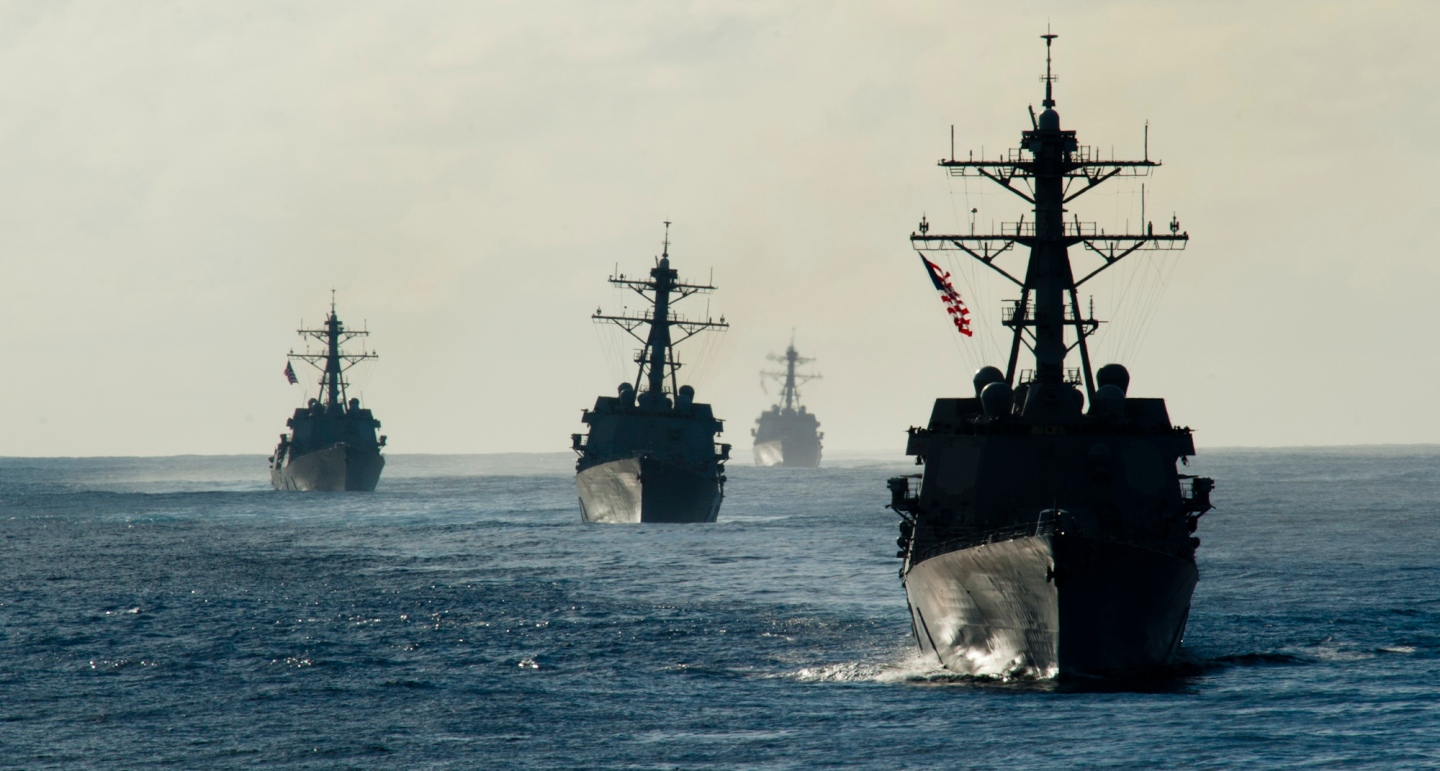
Cover image: The guided missile destroyers USS Kidd (DDG 100), USS Dewey (DDG 105), USS Pinckney (DDG 91) and USS Wayne E. Meyer (DDG 108) sail in formation in the Pacific Ocean Feb. 12, 2012. The destroyers were part of the John C. Stennis Carrier Strike Group and were operating in the U.S. 7th Fleet area of responsibility. (DoD photo by Mass Communication Specialist 3rd Class Kenneth Abbate, U.S. Navy/Released)
Source bibliography:
- Doshi, Rush. “Introduction.” In The Long Game: China’s Grand Strategy to Displace American Order, 1-26. Oxford: Oxford University Press, 2021. https://www.brookings.edu/articles/the-long-game-chinas-grand-strategy-to-displace-american-order/
- Medcalf, Rory. “China and the Indo-Pacific: Multipolarity, Solidarity and Strategic Patience.” Chaire Grands Enjeux Stratégiques Contemporains, March 12, 2018. https://chairestrategique.pantheonsorbonne.fr/themes/2018/china-and-indo-pacific-multipolarity-solidarity-and-strategic-patience.
- Poon, Jessie P.H., Peng Peng, and Xiaoying Qian. “End of the Asia-Pacific: Geoeconomics, Belt and Road and the Indo-Pacific.” Political Geography 108 (2021): 102-118. https://www.sciencedirect.com/science/article/pii/S0962629821001234
- Kanth, Mujeeb. “Metageographic Practices of the Indo-Pacific: Competing Constructions of Geostrategic Space in Maritime Asia.” Yearbook of Strategic and Security Studies 1 (2022): 45-67. https://www.academia.edu/114373163/Metageographic_Practices_of_the_Indo_Pacific_Competing_Constructions_of_Geostrategic_Space_in_Maritime_Asia
- Wisnugroho, Aisya Muyassara. “New Regionalism: Belt and Road Initiative and the Indo-Pacific Region.” Modern Diplomacy, June 30, 2024. https://moderndiplomacy.eu/2024/07/01/new-regionalism-belt-and-road-initiative-and-the-indo-pacific-region/#_edn24.
- Heiduk, Felix, and Gudrun Wacker. “From Asia-Pacific to Indo-Pacific.” Stiftung Wissenschaft und Politik (SWP), July 1, 2020. https://www.swp-berlin.org/10.18449/2020RP09/#hd-d24373e1058.
- Pillsbury, Michael. “The Trump Administration’s Indo-Pacific Strategy.” In The Struggle for Power: U.S.-China Relations in the 21st Century, edited by Leah Bitounis and Jonathon Price, 31-38. Washington, DC: The Aspen Institute, 2019
- Vaimiti Goin, « The Indopacific Space, a Geopolitical Concept with Varying Geometry in a Field of Competing Powers », Géoconfluences, October 2021. Translated from French by Charlotte Musselwhite-Schweitzer in March 2024. https://geoconfluences.ens-lyon.fr/programmes/dnl/dnl-hg-anglais/indopacific-space-geopolitics
- Ikenberry, G. John. Liberal Leviathan: The Origins, Crisis, and Transformation of the American World Order. Princeton, NJ: Princeton University Press, 2011.
- Brooks, Stephen G., and William C. Wohlforth. America Abroad: The United States’ Global Role in the 21st Century. New York: Oxford University Press, 2016.
- Cox, Michael. “Power Shifts, Economic Change and the Decline of the West?” International Relations 26, no. 4 (2012): 369-388. Accessed November 13, 2024. https://www.researchgate.net/profile/Michael-Cox-24/publication/258142723_Power_Shifts_Economic_Change_and_the_Decline_of_the_West/links/5cb997214585156cd7a2cb5d/Power-Shifts-Economic-Change-and-the-Decline-of-the-West.pdf.
- Ikenberry, G. John. A World Safe for Democracy: Liberal Internationalism and the Crises of Global Order. New Haven, CT: Yale University Press, 2020.
- Posen, Barry R. “Command of the Commons: The Military Foundation of U.S. Hegemony.” International Security 28, no. 1 (2003): 5-46.
- Schweller, Randall L., and Xiaoyu Pu. “After Unipolarity: China’s Visions of International Order in an Era of U.S. Decline.” International Security 36, no. 1 (2011): 41-72.
- Tooze, Adam. Crashed: How a Decade of Financial Crises Changed the World. New York: Viking, 2018.
- Wright, Thomas J. All Measures Short of War: The Contest for the Twenty-First Century and the Future of American Power. New Haven, CT: Yale University Press, 2017
- Kirshner, Jonathan. American Power after the Financial Crisis. Ithaca: Cornell University Press, 2014.
- Mastanduno, Michael. “System Maker and Privilege Taker: U.S. Power and the International Political Economy.” World Politics 61, no. 1 (2009): 121-154.
- Kindleberger, Charles P. The World in Depression, 1929-1939. Berkeley: University of California Press, 1973
- Fukuyama, Francis. “The End of History?” The National Interest, no. 16 (1989): 3-18 https://pages.ucsd.edu/~bslantchev/courses/pdf/Fukuyama%20-%20End%20of%20History.pdf
- Mastro, Oriana Skylar. “The Stealth Superpower: How China Hid Its Global Ambitions.” Foreign Affairs 98, no. 1 (2019): 31-39. https://www.foreignaffairs.com/articles/china/china-plan-rule-asia
- Yan, Xuetong. Leadership and the Rise of Great Powers. Princeton, NJ: Princeton University Press, 2019. DOI: 10.1515/9780691191935
- Scott, David. “The Indo-Pacific in US Strategy: Responding to Power Shifts.” RP Quarterly 3, no. 2 (2018): 45-67. https://rpquarterly.kureselcalismalar.com/wp-content/uploads/2018/10/vol3.2-scott.pdf.
- “EU Indo-Pacific Flagship Projects.” EEAS, February 5, 2024. https://www.eeas.europa.eu/eeas/eu-indo-pacific-flagship-projects_en.
 Encyclopedia Geopolitica
1 comment
Comments are closed.