
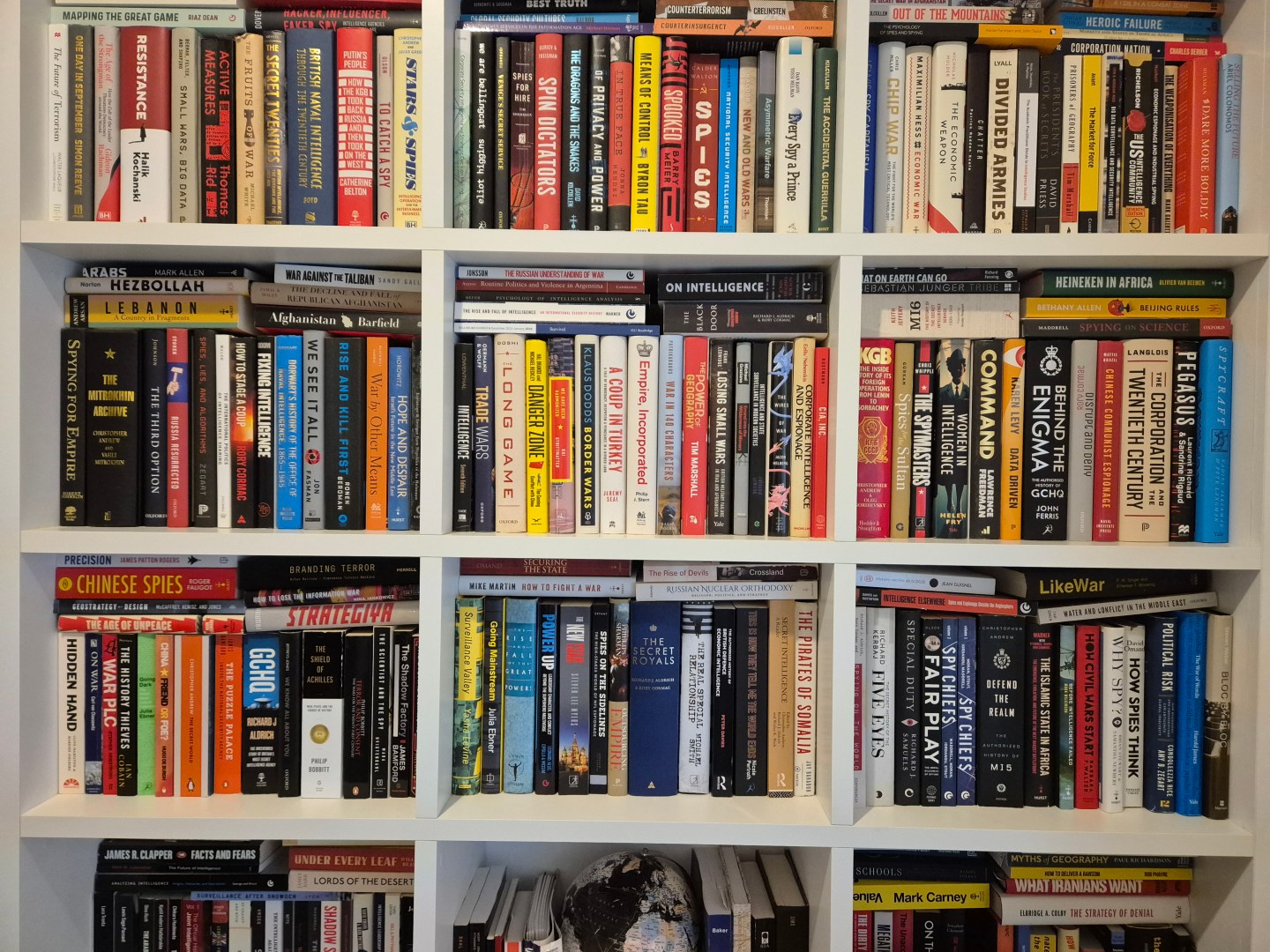
2025 has continued the ongoing trend of chaos, conflict, and – at times – confusion in the geopolitical arena. The war in Ukraine continues towards a possible apex in 2026, as the crisis in the Middle East has crescendoed to spectacular US and Israeli strikes on Iran, before falling into a lull. An unexpected war in Venezuela looks ever more likely, and and an economic war continues between the superpowers. All of this has continued to remind the world of the criticality of geopolitics for governments, businesses, and populations alike. 2026 looks to be no calmer for analysts and global affairs watchers, with great power competition, conflict, and challenges to established global orders continuing to dominate the geopolitical landscape. In this annual piece – which supplements our regular geopolitical book reviews – we recommend the best books for analysts, students, and other global affairs-watchers to better understand what drives geopolitics, how best to interpret world events, and what their future consequences could be. Members of the Encyclopedia Geopolitica team offer you their personal choices to help you better understand geopolitics in 2025.
Disclosure: Purchases made using the links in this article earn referrals for Encyclopedia Geopolitica. As an independent publication, our writers are volunteers from within the professional geopolitical intelligence community, and referrals support our ability to create future content by funding server and domain fees. As such, we strongly encourage you to liberally indulge in your book-buying urges through our links! You can also support Encyclopedia Geopolitica and contribute to the running costs of the site directly via Patreon (where you can get access to special perks) or by tipping us on Ko-fi.
Team Recommendations
Lewis Sage-Passant – Founder and Editor-in-Chief
Chokepoints: How the Global Economy Became a Weapon of War – Edward Fishman – 2025
In Chokepoints, former State Department sanctions official Edward Fishman explores how – over the last 20 years – the US government’s use of sanctions, technology dominance, and other tools of economic warfare has replaced military action as the weapon of choice for destabilising adversarial regimes. This book is a critical read for geopolitics watchers in 2026 given the US’ renewed vision of its place in the world, and growing dissatisfaction with the previously self-championed ideals of globalisation. Against this backdrop, sanctions have gone from an ineffective tool to the most impactful item in the US’ arsenal. This, Fishman argues, is one of the most critical geopolitical developments of the modern era, driving a new economic cold war. Chokepoints serves as both an excellent introduction to the theory and practice of sanctions, while also serving as a geopolitical history of the current millenium, and is recommended for intermediate to advanced geopolitics readers.
The End of Everything: How Wars Descend Into Annihilation – Victor Davis Hanson – 2024
In “The End of Everything”, Victor Davis Hanson explores the brutal fall of four ancient civilizations as a result of catastrophic military losses, and through these histories, how conflicts can drop stunningly prosperous societies into barbarism. This book is a valuable reminder for geopolitics watchers in 2026, with 2025 having been a year marked by brutal conflicts. In particular, with war on Europe’s doorstep and alliances looking ever more fragile, the lessons Hanson draws hold significant weight. “The End of Everything” is an excellent read for geopolitics watchers of all levels, and serves as an important reminder of the stakes at play in today’s conflicts.
The Protective Intelligence Advantage – Fred Burton and Scott Stewart – 2025
Burton and Stewart – two of the most experienced voices in the field of protecting high profile diplomats, celebrities, and business leaders – bring “The Protective Intelligence Advantage” to bookshelves at a timely moment. With the 2024 killing of United Healthcare CEO Brian Thompson still fresh in the public perception, the global economy bifurcating further between the wealthy and the rest, and public anger at elected and business leaders reaching new heights, this book brings practical advice at a critical time. With both authors having appeared on Encyclopedia Geopolitica’s “How to get on a Watchlist” podcast, with Burton having discussed the threat to diplomats and Stewart having discussed the threats to executives, this book could not have been written by more knowledgeable and well-placed authors. This book is particularly recommended for those readers considering careers in the intelligence field, as it represents one of the best books focused on the niche (but rapidly growing) protective intelligence sector.
Simon Schofield – Editor
Iran’s Shadow Weapons: Covert Action, Intelligence Operations and Unconventional Warfare – Jonathan Hackett – 2025
One of the most fascinating puzzles of modern geopolitics is how the Iranian regime in Tehran thinks. Jonathan Hackett, a retired US Marine with a wealth of experience in intelligence affairs, has produced a fantastic work, incorporating primary sources such as declassified intelligence material, to really help understand what the various factions and moving parts within the regime are, what their relationships are with one another, what motivates them, and what strategies they adopt and tactics they deploy to achieve their goals. Iran is likely to remain a major source of interest and intrigue over the next years, and this book will make a fantastic companion for anyone seeking to understand how parts of the regime think and how they are likely to pursue their aims.
Beirut Rules: The Murder of a CIA Station Chief and Hezbollah’s War Against America – Fred Burton and Samuel Katz – 2025
This book is scheduled for paperback release in December from the authors of Under Fire, a deeply readable and insightful account of the attack on Benghazi. Beirut Rules tells the harrowing story of the kidnapping and murder of CIA Beirut station chief William Buckley at the hands of Hezbollah, an inflection point in modern history the consequences of which are still playing out today. Burton and Katz have an engaging writing style that grips like a thriller, without resorting to hyperbole, based on their in-depth research and high degree of access to those who were there, including government sources and Buckley’s friends and family. As mentioned under Lewis Sage-Passant’s reviews, Burton-being a longstanding friend to Encyclopedia Geopolitica-discussed this case with us on the “How to get on a Watchlist” podcast.
A History of Modern Mercenary Warfare – Harry McCallion – 2024
Published in April 2024, this book is already out of date, given the speed at which things are developing in the world of warfare. However, as we predicted in 2020, the new foreign legions, both corporate and governmental, are being used to reshape the battlefield. From North Koreans fighting for Moscow in Ukraine, to Colombian mercenaries training child soldiers in Sudan, this phenomenon shows no sign of abating, and will only become more prevalent in 2025. Harry McCallion has served in the British and South African militaries, as well as a number of private military companies across many theatres, and has wide and deep connections, particularly in the British mercenary sphere. This book offers a “warts and all” portrait of the development of the modern mercenary, and a range of interesting case studies, which will provide invaluable insight into how mercenaries are deployed across the globe.
Aleksandra Szylkiewicz – Deputy Editor
The Wizard of the Kremlin – Giuliano da Empoli – 2023
Marking da Empoli’s international breakthrough, this novel blends political fiction and non-fiction with sharp, perceptive insight. The European scholar delivers some of the most astute observations on power and its dynamics within Putin’s Russia and beyond. Told through the reflections of Vadim Baranov — an adviser inspired by real Kremlin strategists, and in particular Vladislav Surkov — The Wizard of the Kremlin is a poignant yet highly accessible read for anyone seeking to understand Putin’s rise and the domestic and international forces that continue to shape Russia’s geopolitical posture. Da Empoli moves elegantly between politics and psychology, between individual ambition and national strategy. The story spans Baranov’s childhood memories, his initial career in the artist milieu, through his years at Putin’s side in the late 1990s and early 2000s, as the future president consolidated control. Baranov’s narrative is deeply human, pushing readers to question their own perceptions and their presumed immunity to manipulation. As the war in Ukraine continues and technological advances further enable mass persuasion amid weakening social contracts across the West, The Wizard of the Kremlin offers an urgent lesson for 2026. It is also a sobering reminder of how fragile progress can be — and how, in our era, perception often eclipses reality.
They Thought They Were Free: The Germans 1933-45 – Milton Sanford Mayer – 2017
This remarkable work of non-fiction traces the rise of fascism in Germany by examining the lives of ten ordinary citizens. Drawing on extensive postwar interviews, Mayer allows these men to speak for themselves, inviting readers to see the changes in Germany in 1933-45 through their eyes. He skillfully transports us back in time, revealing how incremental changes, social pressures, fear, and the desire for belonging gradually reshaped a society. First published in 1955, the book feels strikingly timely as we enter a turbulent 2026. Through the lens of ten everyday lives, it shows how people often fail to recognise authoritarianism when it emerges slowly and quietly, and how democratic values and moral boundaries can erode almost imperceptibly, both for individuals and for a society as a whole. A humbling and often surprising read, They Thought They Were Free is especially important today as a reminder of the role civic responsibility and vigilance play in preserving freedom.
The World for Sale: Money, Power, and the Traders Who Barter the Earth’s Resources – Javier Blas, Jack Farchy – 2022
The World for Sale lays bare the powerful intersections between markets and politics that are often invisible to the public eye, revealing how commodity traders shape global events from behind the scenes. With trade wars, tariffs, conflicts, and supply-chain disruptions set to remain central geopolitical concerns in 2026, and with the race for AI supremacy intensifying competition for critical resources, Blas and Farchy offer essential reading for anyone seeking to understand the ins and outs of raw materials commodity trading. Although commodities lie at the heart of modern geopolitics, the industry that trades them operates largely out of public view and media headlines, and is frequently misunderstood. In The World for Sale, the authors illuminate past moments when raw material trading and profit-driven decision-making deeply influenced global politics, producing ripple effects on entire nations, regime stability, and national security. Masterful in its storytelling, the book combines sharp analysis and meticulous reporting with a human touch. It would make a great addition to any geopolitics aficionado’s bookshelves for the years to come
Colin Reed – International Security Analyst
Blood in the Machine: The Origins of the Rebellion Against Big Tech – Brian Merchant – 2023
2025 saw the emergence of widespread popular disillusionment with Big Technology, with growing awareness among expert analysts and the general public alike of the power a small group of cloistered, American, tech elites have over the ways in which we live, work, and conduct our politics. But there is nothing truly unprecedented in human history, and Brian Merchant’s Blood in the Machine is the right work at the right time for the AI moment. Merchant attempts to assemble the first modern history of the Luddite movement, a popular mass uprising in the 19th Century that saw skilled weavers rapidly displaced by corporate consolidation and the widescale adoption of automated weaving machines. Merchant’s narrative is at its best when it is adeptly dissecting the all-too-modern concerns of the workers, families, government officials, and artists living through the Luddite rebellion, and in assessing the ways in which platform monopolization, automation, and divestment of workers from the products of their labour resonate across centuries. He also provides a fascinating insight into the effort that government officials and big businessmen plowed into destroying the Luddite story, illustrating how a nuanced tale of desperate and determined skilled craftsmen has been twisted over the centuries to stand in as a watchword for flat-headed anti-progressive obstinacy. Blood in the Machine is not perfect – its narrative is uneven, it stretches its resources too thinly in attempting to achieve dramatic pacing, and likely could have benefited from a structural edit. Still, there was nothing else written this year which better describes the human resonance of the current moment with its Industrial-era precursor.
Iran’s Grand Strategy – Vali Nasr – 2025
With the return of Trump to the White House, and the ongoing Israel-Gaza conflict continuing to rage, Iran’s role in the modern Middle East was again a major story of 2025. The summer saw direct conflict erupt between Israel and Iran, and the United States carried out a direct kinetic attack against Iran’s nuclear weapon facilities. Years of Global War on Terror thinking has made it easy for Western observers to forget that Iran is not merely a reactive bogeyman mindlessly seeking maximal regional chaos, but instead has a coherent geopolitical conception rooted in decades of grand strategic thinking. Indeed, a reminder to democratic audiences that authoritarian regimes tend to be far more consistent in their thinking over time is always welcome, and Nasr’s work is one of the most accessible and engaging accounts of Iran’s geopolitical goals in recent memory. Centring the ways in which the Islamic Republic sees itself at the heart of the narrative, Nasr’s work should be a first stop for anyone trying to assess where events in the Middle East will trend in 2026, particularly as Tehran faces massive challenges on climate, security, and demographic fronts.
The Pacific Circuit – Alexis Madrigal – 2025
In a year of tariffs and broken supply chains, The Pacific Circuit by Alexis Madrigal is an incisive and timely examination of the infrastructure and strategic dynamics that bind the United States and Asia into a single, interdependent system. Drawing on deep historical research and sharp contemporary reporting, Madrigal illuminates the undersea cables, shipping corridors, datacentres, and logistical architectures that constitute the real backbone of global power in the twenty-first century. For the geopolitical analyst, his account shows how these networks both reflect and reshape competition among states, exposing critical chokepoints, supply-chain vulnerabilities, and the uneven distribution of technological capacity across the Pacific Rim. Madrigal’s blend of narrative clarity and systems-level analysis makes The Pacific Circuit an essential work for understanding how physical and digital supply chains have become the defining terrain of modern geopolitics.
John Fee – Northern Europe Security Analyst
The Art of War and Peace: The Changing Face of 21st Century Warfare – David Kilcullen and Greg Mills – 2025
In a world of mounting disorder reminiscent of the 1930s, David Kilcullen and Greg Mills diagnose a pre-war footing where battlefield supremacy no longer guarantees durable peace. Their work confronts an enduring challenge of modern conflict: why, after decades of technological and tactical advancement, do states so consistently fail to convert battlefield victory into sustainable political success? Emerging from this query is an honest appraisal of what has worked and failed in the past; drawing on fieldwork from the frontlines of Ukraine to the battlefields of the Ethiopian highlands. Kilcullen and Mills bypass simple critiques of technology or strategy to locate a persistent gap between local actors and intervening powers, compellingly arguing for a new strategic framework built on a shared, ground-up understanding of security threats and a unified capacity to respond. For readers interested in the turbulent interplay of military, political, and economic forces that dictate the outcome of war, this book delivers.
War – Bob Woodward – 2024
Bob Woodward’s War offers a riveting, fly-on-the-wall account of the high-stakes decisions that defined the Biden presidency and recast the contours of a new era of global conflict and alignment. The book chronicles President Biden and his national security team’s intelligence-driven, collaborative efforts to deter aggression and mitigate conflict escalation, thereby offering readers a real-time case study in policy pressure-testing and alliance coordination. Woodward reminds us that while structural forces may set the stage of geopolitics, it is the instincts, neuroses and relationships of its active players that ultimately direct the drama.
End Times: Elites, Counter-Elites, and the Path of Political Disintegration – Peter Turchin – 2024
Peter Turchin’s work offers a timely prognosis for the ongoing crisis of political dysfunction across complex Western polities. A book we previously reviewed in 2023, this analysis warrants further re-examination, as the intervening period has only underscored the urgency of its findings. He argues that our current predicament is not random but the inevitable result of predictable historical forces – namely, a toxic combination of too many aspiring elites fighting for too few positions in the upper echelons of society, and a populace struggling with a declining standard of living. Turchin, a former ecologist, applies his science of history, analysing vast datasets to identify recurring, predictable patterns in how societies enter and exit these periods of instability across millennia. The overall conclusion is grim: historical cases in which societies navigated such crises without major consequences are vanishingly rare. Turchin offers a sober roadmap of the prospective dangers that await us amid the ensuing ‘turbulent twenties’, forcing practitioners to engage with the impersonal, long-term structural pressures vital for understanding the emerging risk landscape.
Edwin Tran – Levant Region Analyst and “How to get on a Watchlist” Producer
Nasser’s Blessed Movement: Egypt’s Free Officers and the July Revolution – Joel Gordon – 2016
Joel Gordon’s work examines the fall of the Egyptian monarchy, the rise of Republican Egypt, and the charismatic figure of Gamal abd’ al-Nasser. The book traces an array of nuances, illustrating the whole patchwork of key figures, competing organizations, and defining events. The details are deep and the attention to history is engaging. As a biography of one of the most dynamic countries in the early days of the Cold War, this is a must read.
A Peace to End All Peace: The Fall of the Ottoman Empire and the Creation of the Modern Middle East – David Fromkin – 2009
David Fromkin’s work has been recommended by many for good reason. It highlights one of the most consequential theaters of the First World War, one which has underlined many modern conflicts. At the same time, Fromkin expertly offers a different perspective, giving insight into the decisions and motivations of European countries and leaders with regards to the Ottoman Empire. By shining this light, Fromkin provides even greater clarity on how personal ambitions and lines on the map can result in a world of devastating consequences.
Turkish Kaleidoscope: Fractured Lives in a Time of Violence – Jenny White and Ergun Gunduz – 2021
The 1970s were a contentious period for the Republic of Türkiye. In scenes that echo the current era, the political landscape is fractured, drawn between far-right and far-left battlegrounds. In a graphic novel form, Turkish Kaleidoscope explores this sundered environment from the ground level. It follows individuals, people, who must navigate this confusing landscape, and examines how the average person interacted between politics and ever-growing violence. The work is an interesting medium that spotlights an underexamined period of history, one that mirrors back to our own era.
Eamon Driscoll – Russia and Former Soviet Spaces Analyst
Ukrainian Sunrise: Stories of the Donetsk and Luhansk Regions from the Early 2000s – Kateryna Zarembo – 2024
Through Zarembo’s book, the narrative of uniformly pro-Russian regions of Ukraine gets a strong challenge. Focusing on society in the Donet’sk and Luhansk regions in the 2000s, readers will see how local cultural, civic, and youth movements were establishing a Ukrainian identity even in the shadow of Soviet legacy and post-independence industrial decline. It is a reminder that the stories we tell are not set in stone, and that the Kremlin’s propaganda narratives are superficial at best. Looking forward, these stories may well be used as part of Ukrainian revanchism, as justification for a future restoration of these lost territories. For those interested in Ukraine, Zarembo provides powerful insights into the local identity and memory. Readers will not be disappointed in learning about this dynamic region and how it was evolving prior to the Russian invasions of 2014 and 2022, and will receive a deeper understanding of this conflicts roots and the cost paid by those who once called this land home.
After January: Kazakhstan’s Journey Through Identity and Geopolitics – Dinara Pisareva, Nurmakhan Tastaibek & Nygmet Ibadildin – 2025
In the wake of the “Bloody January” protests of 2022, Kazakhstan has had to walk its path to navigate foreign policy and secure its own identity. The authors of After January trace the modern Kazakh historical narrative from its origins under the Russian Empire and USSR, through the social contract of technocratic stability under President Nazarbayev, and into its recent political history. Readers will explore Kazakhstan’s domestic identity, memories of famine & collectivisation, and external pressures which continue to shape its present and future. Those interested in Central Asia will enjoy how After January examines Kazakhstan navigating global and regional politics, reframing the “Great Game” to consider the perspective and ambitions of the largest of the Central Asian nations, rather than treating it as a resource-rich client state to be fought over by greater powers.
How Russians Understand the New Russia: Consolidation and Contestation – Paul Chaisty & Stephen Whitefield – 2025
Though much about the Kremlin and Vladimir Putin has been written or speculated on, Chasity & Whitefield offer a reframing of the narrative. Focusing instead on how Russian citizens understand the “hybrid political economy” in the post-Soviet order. While the chaos and turbulence of the 1990s was brought to an end by Putin, and this system helped stabilise the country, it also brought the risks of reopening issues of territory and identity. The switch from viewing Ukraine as a brotherly Slavic nation to a perceived fascist state in league with the West against Russian traditional values has reopened fault lines in society and forced a reversion of the openness that ended the Soviet Union. This book goes beyond the superficial narrative of Russia as an authoritarian state, and dives deep into the thoughts and mindset of ordinary Russians. It’s an understanding driven by data inro the “New Russia”, and how its citizens cope with stability but limited avenues for dissent, and how events outside the borders, such as the sanctions and war in Ukraine, impact domestic action and opinion.
Archie Hicox – Military Analyst
The Big Red Train Ride – Eric Newby – 1979
The Big Red Train Ride by Eric Newby was written in 1977 and provides a unique historical insight into the USSR. It is an overlooked gem of travel writing that masks cutting historical observations with an acerbic wit. You should read this book because it provides a forensic analysis of Russian settlements from West to East as Newby rides the Trans-Siberian Railway; it explains the interplay of geography and history within a post-Stalin context, but as a modern reader we can view it through a 2025 lens of what Russia will become in the 1991-2025 era. Interestingly as an aside, at the time the book was written and Newby was travelling across the USSR, Vladimir Putin was a counter intelligence officer in St. Petersburg. I would suggest that this is why this book matters and why you should read it: In Russia, context is key.
Alex Smith – Asia Pacific and China Military Affairs Analyst
China’s Quest for Military Supremacy – Joel Wuthnow and Phillip C. Saunders – 2025
Considering its importance, there is a surprising dearth of books (in English, at least) that give such a useful and contemporary overview of the PLA as Wuthnow and Saunder’s recent joint work. In a punchy eight chapters, China’s Quest for Military Supremacy covers a lot of ground, from the role of the PLA as a “pillar” of CCP rule, China’s strategic outlook, and the corresponding priorities that are shaping PLA modernisation. Further chapters examine the PLA’s modernisation of conventional forces along with nuclear, cyber and space. Increases in China’s military diplomacy are also considered, along with chapters dedicated to a Taiwan conflict and the PLA’s growing role outside of Asia. Despite being leaders in the field, Wuthnow and Saunders manage to avoid overly technical explanations or levels of detail while delivering enough information to serve both as a must-read for anyone new to the topic and a singularly useful distillation of key issues for the initiated.
Purchases made using the links in this article earn referrals for Encyclopedia Geopolitica. As an independent publication, our writers are volunteers from within the professional geopolitical intelligence community, and referrals like this support our ability to create future content by funding server and domain fees. As such, we strongly encourage you to liberally indulge in your book-buying urges through our links! You can also support Encyclopedia Geopolitica and contribute to the running costs of the site directly via Patreon (where you can get access to special perks) or by tipping us on Ko-fi.
Conclusion
Encyclopedia Geopolitica celebrated its 9th birthday this month, and as always, we owe our success to our loyal readers, who have supported our work on platforms such as Twitter, Instagram, and Reddit. We are especially grateful to patrons of the site, who help fund our website and podcast running costs directly on Patreon, or indirectly via book purchases using our affiliate links.
The site’s founder and editor, Lewis Sage-Passant, would also like to extend a special thanks to the hardworking team of analysts and co-editors, without whom the project could not continue. As a volunteer organisation, their contribution has been as critical as ever to this project! We suspect that 2026 will bring more geopolitical shocks as the international tectonic plates continue to shift. We plan to keep bringing you insightful and informative articles on those niche and under-examined geopolitical developments that we have tried to accurately capture this year, and hope that these books will help you to understand the world’s challenges a little better. Thanks as always for reading!
Encyclopedia Geopolitica is a collaborative effort to bring you thoughtful insights on world affairs. Our contributors include Military officers, Geopolitical Intelligence analysts, Corporate Security professionals, Government officials, Academics and Journalists from around the globe. Topics cover diplomatic and foreign affairs, military developments, international relations, terrorism, armed conflict, intelligence, espionage and the broader elements of statecraft.
Picture credit: Encyclopedia Geopolitica Graphics Team
 Encyclopedia Geopolitica