
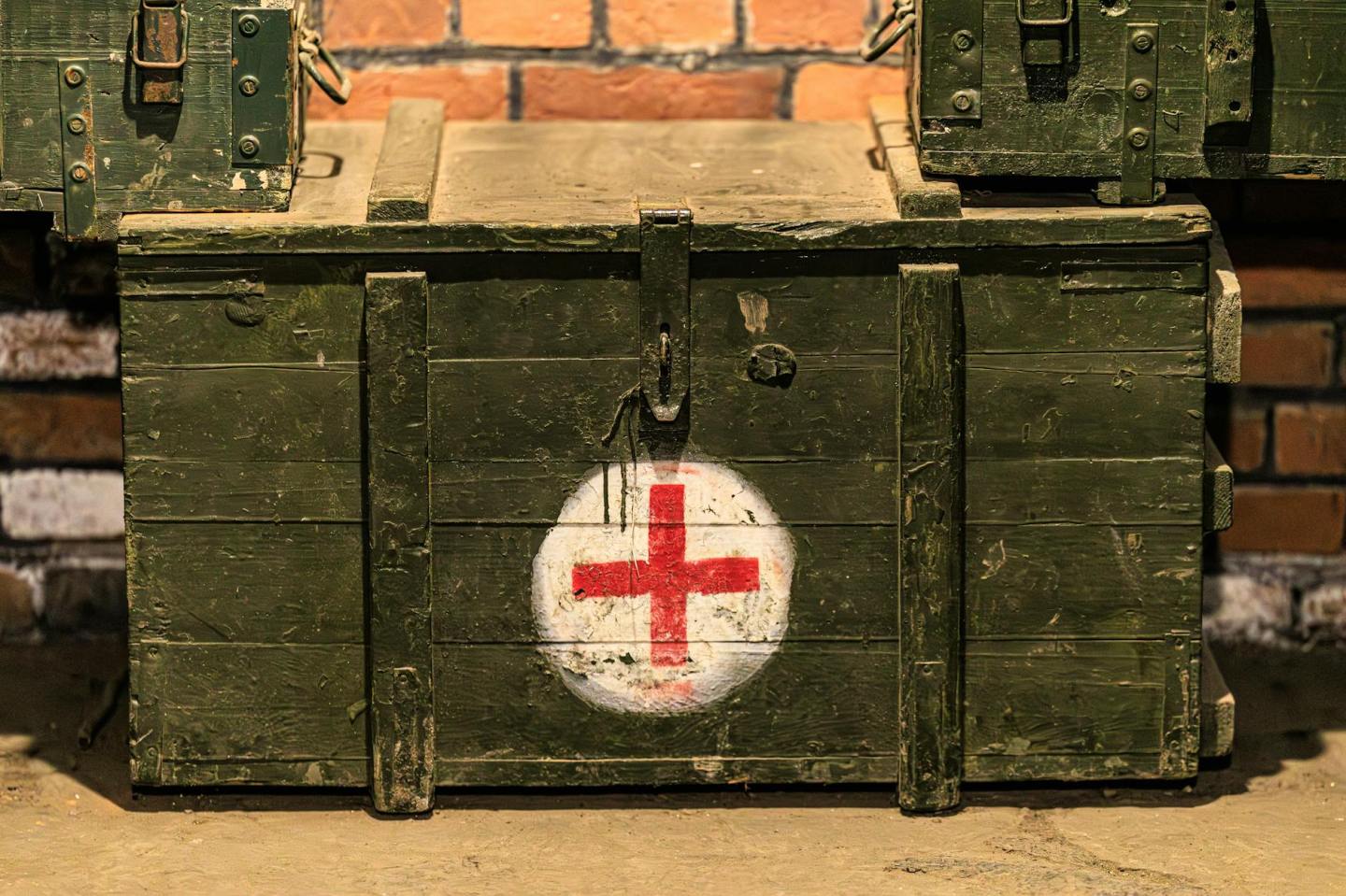
In this piece, contributor David Stanton responds to recent commentary on battlefield medics published in War on the Rocks and explores how conventional norms of protected medicine in battlefield environments are not eroding, but have in fact been challenged for some time. David argues that the myth of the protected battlefield medic is harmful to institutional adoption of mitigations that can actually increase the viability of effective combat medicine.
Throughout modern history, a persistent narrative suggests that medics on the battlefield are regarded as protected under limited-combatant status and will therefore have access to conduct medical treatment relatively unhindered. This myth has come under fire in recent years, with commentary suggesting that modern, peer-combat has now shattered the assumption that medics can expect meaningful sanctuary on the battlefield. The argument is not wrong, but Ukraine did not create that reality. The more damaging truth is that the vulnerability of medical personnel in conflict is not a new lesson but a long-established reality that institutions have chosen, repeatedly and deliberately, to look past. Ukraine has only stripped away the last institutional excuse for denying what frontline providers, humanitarians and evacuation teams have known for years.
Medical Personnel Have Always Faced Extreme Danger
The International Committee for the Red Cross launched its Health Care in Danger initiative in 2012, after years of documented attacks on healthcare facilities, personnel and transport across multiple theatres. The World Health Organization has tracked violence against health workers as a global health concern for more than a decade. The Safeguarding Health in Conflict Coalition recorded more than 3,600 incidents of violence against or obstruction of healthcare across 36 countries and territories in 2024 alone. That is a 15 percent increase from 2023, a 62 percent rise from 2022, and the highest annual total since monitoring began. On average, health care comes under attack ten times a day. Those numbers include Gaza, Lebanon, Myanmar, and Ukraine. The pattern is not new and the documentation is extensive.
Modern narratives suggest that the nature of conflict in Ukraine is posing unique challenges to medicine in conflict environments, but the reality is medical providers have been under fire consistently in recent decades in Syria, Yemen, and Afghanistan. Afghanistan was particularly dangerous for healthcare providers, including in a 2015 incident when an American Air Force AC-130 gunship struck a Médecins Sans Frontières trauma center in Kunduz, killing 42 people including 14 staff members and a further 24 patients. MSF had warned all warring parties of the hospital’s location well in advance. It was the only trauma center in Northeastern Afghanistan. The strike barely registered as a strategic inflection point and no criminal accountability followed despite investigations by both the United States and NATO.
The lesson available in 2015 was the same lesson being relearned now: protected status is neither self-enforcing nor reliably honored, and the consequences of pretending otherwise fall on those who are providing the care. The failure is not limited to how institutions respond to attacks on medical personnel. It extends to how they have failed to adapt the one model that was built precisely for this reality.
Recent commentary published in War on the Rocks focuses almost entirely on the U.S. military’s failure to produce tactically proficient medics at scale. That is a real problem. But it glosses over an inconvenient fact: the U.S. military already solved this challenge, at least in one part of the forces, decades ago. The 18 Delta, the Special Forces Medical Sergeant, is trained to operate in austere, denied, non-permissive environments, deliver far-forward trauma care, and function as a combatant. Air Force Pararescuemen train to the same standard. SEAL Special Operations Independent Duty Corpsmen, SARC operators, Ranger medics, and 160th SOAR flight medics all attend the same Joint Special Operations Medical Training Center. The warrior-medic model held up as an aspiration exists, at high-fidelity, across the special operations community. It has for decades. The conventional force’s failure to adapt that model is not an absence of proof of concept. It is an absence of institutional will.
Why the Myth of the Protected Medic Endures
The idea of the protected medic is morally necessary, legally useful, and institutionally comforting. That is precisely why it exists long past the point where it reflects operational reality. Morally, abandoning the norm feels like abandoning the principle. Legally, it provides a framework for accountability, however imperfectly. Institutionally, it allows planners to work with assumptions that simplify an otherwise unmanageable problem. Once that legal principle hardens into an operational assumption, it begins to mislead: it shapes where aid stations are sited, how casualty movement is timed, what signatures are tolerated, and how much risk commanders allocate to medical personnel before the system starts to fail. NATO has shown awareness of this problem at the operator level for years. The institutional adaptation has not kept pace. I knew Pete Reed. A former Marine turned humanitarian medic, Reed was operating in Bakhmut, Ukraine in 2023 when a Russian anti-tank guided missile hit his ambulance as his team attended a wounded civilian. The vehicles being used in the rescue were marked with red crosses. The crew was unambiguously identifiable. Independent video analysis reviewed and verified by ABC News concluded the targeting was deliberate. Surviving team members described a classic double-tap strike: create a medical response, wait for responders, hit the responders. Nobody on that street was operating under any assumption of protection. The myth had died for them long before the missile arrived.
Reed’s case is not an outlier. It is just another datapoint in a trend that humanitarian organizations have been documenting, with increasing alarm, for over a decade. The working medic under drone surveillance has no illusions about protected status. The evacuation team that learned to move at night, suppress radio traffic, and abandon marked vehicles because marked vehicles got targeted understood the operational reality long before the institution followed.
What Must Change
The humanitarian medical community has been the military’s unacknowledged early warning system on this problem for over a decade. The military has not been listening. The problem is not ignorance at the front and it never has been. The problem is institutional denial at the rear. Reforming the warrior-medic pipeline is important and necessary. It is also insufficient if the planning assumptions that govern how medical support is employed do not change alongside it. Training medics to fight and survive is not the same as training the institutions to stop pretending that legal protections translate to practical safety. Three things need to happen.
First, medical planning must stop operating on the assumption that perceived historical protections will be honoured. They won’t. That means different siting of infrastructure, different evacuation doctrine, different signature management, and different exposure tolerance from the start.
Second, the documented instances of attack on healthcare collected by organizations like the ICRC, WHO, and SHCC must be treated as operational intelligence, both for the military as well as NGOs, rather than as separate conversations happening in different professional communities. The military medical system and the humanitarian medical system are operating in the same threat environment. They should be drawing from the same threat picture.
Third, the military, particularly NATO, needs to close the gap between what active operators understand and what the institutions plan and train for. Prolonged Field Care is not the domain of special forces, it is the domain of modern conflict. The gap is not a knowledge problem, it is a political and bureaucratic one and Ukraine has simply made it harder to excuse.
The Kunduz strike did not produce that reckoning. The documentation of over 2,500 attacks on health infrastructure in Ukraine since 2022 has not fully produced it either. What each of these moments has done is narrow the available excuses for institutional inertia.
Final Thoughts
The warrior-medic model is correct. Machaon knew the battlefield was dangerous. He did not need to wait for the war in Ukraine to tell him. What he needed, and what the modern military medical system still lacks, was an institution willing to plan accordingly. The myth of the protected medic is not just an individual soldier training problem. It is a planning problem, a doctrinal problem, and an institutional honesty problem. Ukraine has made it harder to ignore. That is not the same as making it new. Providers at the front have never had the luxury of the myth of protection. It is past time for their institutions to catch up.
Suggested books for in-depth reading on this topic:
- The Gunners’ Doctor: Vietnam Letters (David Bradford)
- Doctor for Friend and Foe: Britain’s Frontline Medic in the Fight for the Falklands (Rick Jolly)
- On call in Hell: A Doctors Iraq War Story (Cdr. Richard Jadick & Thomas Hayden)
- Battleworn: The memoir of a Combat Medic in Afghanistan (Chantelle Taylor)
David Stanton is the Fellow of Security and Resilience at the Centre for Subversion, Unconventional Interventions and Threats at the University of Nottingham where he researches medical intelligence. David has almost 20 years of experience in pre-hospital emergency medicine, a decade of which as a special rescue medic. He has contributed to the development and delivery of austere medical care for numerous organizations including NATO special operations and humanitarian evacuation teams.

