
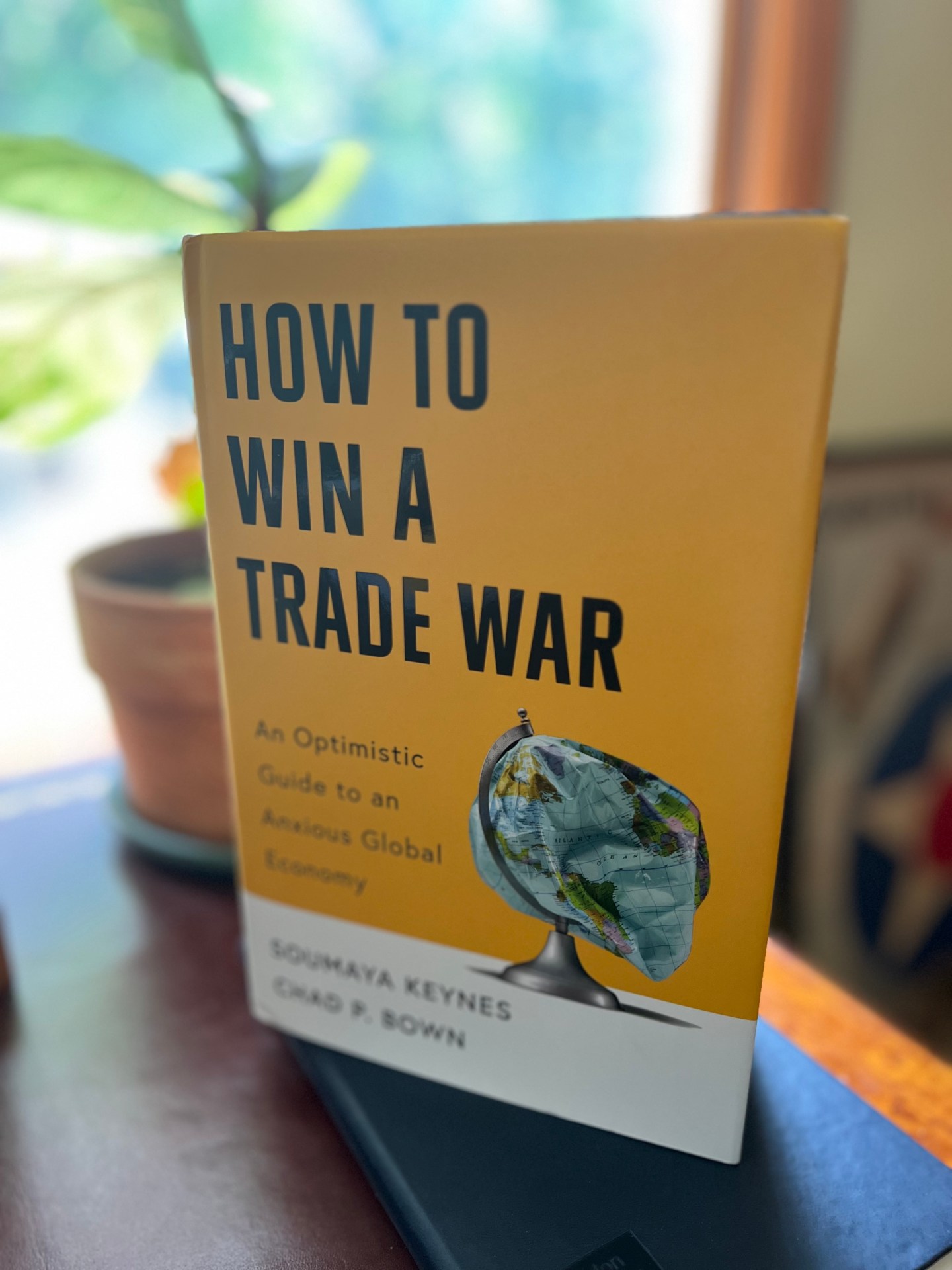
In this piece, Colin Reed reviews How to Win a Trade War: An Optimistic Guide to an Anxious Global Economy by Soumaya Keynes and Chad Bown, and argues that its most valuable contribution is as a field manual for recognising economic coercion as an act of statecraft before it’s too late to respond.
Further book recommendations can be found in our 2026 Geopolitical Reading List.
Conflict, we like to imagine, announces itself. Intelligence organisations are built to watch for the mobilisation order, the massed armour, the missile rolled onto the pad. They are far worse at seeing a war that arrives as nothing more dramatic than a shift in a supplier’s pricing, a quietly expiring export licence, or a subsidy buried in a provincial budget. How to Win a Trade War, the first book from Financial Times columnist Soumaya Keynes and the Peterson Institute’s Chad Bown, is, on its face, an accessible guide to tariffs, subsidies, and supply chains. Read from the chair of an intelligence practitioner, though, it is something more interesting: a chronicle of a strategic surprise that unfolded in plain sight over more than a decade, and a quiet argument about why almost nobody in the West registered it as a threat until it was too late.
Keynes and Bown decline the tidy definition of a trade war as a tit-for-tat spiral of tariffs and adopt a far broader one: a trade war is the weaponization of trade flows, whether through tariffs, export controls, or the slow, deniable pressure of a subsidy-soaked industrial model. On that definition, their most striking claim follows naturally — that the largest trade war of the era was not launched with a giant billboard in the Rose Garden but conducted quietly by Beijing for years before anyone thought to call it one. This is precisely the “diffused surprise” our last review of Avner Barnea’s work touched on: a threat that is ambient, emergent, and lacks a clear return address. An adversary that masses tanks presents a concentrated, legible target; an adversary that merely builds, subsidises, and exports until the rest of the world depends on it presents no target at all, only a potential business partner. The analytic failure the book documents is the failure to make the leap from the second picture to the first — to look at an ostensibly commercial phenomenon and recognise the structure of coercion inside it.
This is not, of course, a novel insight to the small community that studies economic statecraft. Albert Hirschman argued in 1945 that the structure of foreign trade is itself a structure of power, and that dependence is a resource the stronger party can later cash in. More recently, Henry Farrell and Abraham Newman gave the mechanism its modern name — “weaponised interdependence” — describing how states astride the chokepoints of global networks can turn connection into leverage. What Keynes and Bown add is not theoretical novelty but something harder to do well: they render the mechanism legible to the non-specialist, and in the process supply an implicit threat model. Keynes’s own formulation is the sharpest thing in the book for an analyst’s purposes — that the danger is not high dependency alone, but high dependency multiplied by a willingness to exploit it. That is, almost exactly, the capability-plus-intent calculus at the heart of any threat assessment. China’s rare-earth restrictions, or the Nexperia chip crisis that nearly brought global car production to a halt, are not in this reading economic accidents; they are proofs of concept, the demonstration phase of a capability long in development under the banners of Made in China 2025 and dual circulation.
If the book has a limitation for this audience, it is one of professional temperament rather than error. Keynes and Bown are economists, and they diagnose the problem as economists do — as a matter of incentives, data, and policy tools. They are excellent on why the West’s instruments are so blunt; their recurring and correct warning is that a state can decide how an economic weapon is deployed but never how the target will respond. They are genuinely useful, too, on the collection gap, noting how little granular data governments actually hold on their own supply-chain dependencies. But they treat that gap largely as a data problem when it is at least as much an organisational one. The deeper question — who, inside a government or a corporation, is charged with watching for economic coercion, with what tradecraft, and warning whom — is left mostly untouched. It is the Western — and specifically the Five Eyes — tradition that has long fenced economics off from the secret world, treating state collection as an instrument of narrowly defined national security and drawing a self-imposed line against turning it to private commercial advantage. Others never accepted that line: France has run economic intelligence as a formal arm of statecraft for decades; China has made industrial and economic espionage a central pillar of its development model; and South Korea and Israel have likewise treated the economic and technological sphere as natural intelligence terrain, to be both defended and exploited. The gap the book gestures at, in other words, is not a universal absence in the craft but a distinctly Anglo-American blind spot — the more striking because the West now finds itself on the receiving end of exactly the kind of campaign that those other services were built, in part, both to wage and to anticipate. There is still no indications-and-warning apparatus for economic aggression in the Western system to rival the one built over decades for military threats. The authors have written the strategic estimate; the institutional plumbing to solve it, they leave to others.
A second omission matters more to this publication than almost any other, because it concerns the agency of the corporation itself. Keynes and Bown deserve real credit for naming firms as participants rather than scenery — in one exchange they cast the multinational as the “soldier” of a trade war, the actor that actually carries out, or quietly evades, a government’s strategy. Yet even that metaphor concedes too much to the state, casting the company as an instrument through which national strategy is transmitted. The more disquieting reality is that large firms are principals in their own right. They are not merely the terrain a trade war is fought over — the supply chains, the chokepoints, the contested market share — but combatants with war aims of their own. They can lobby a protective tariff into existence, or quietly strangle one that threatens to raise their input costs; they can neutralise a measure altogether by rerouting production through a third country, turning a presidential proclamation into a customs-form exercise; and at the frontier — a chipmaker whose export choices move faster than any sanctions list, a logistics or payments firm sitting astride a network chokepoint — they command leverage that rivals a mid-sized state’s. A trade war, from this point of view, is not a duel between governments conducted over the heads of companies, but a three-body problem in which firms pursue interests that may align with, diverge from, or quietly undercut those of the states nominally fighting on their behalf. The book names the players and largely leaves it there; for the readers who increasingly staff and run corporate intelligence and geoeconomic risk functions of their own, it is exactly this dynamic that requires further mapping.
These gaps do not diminish what the book achieves. The much-remarked “optimism” of the subtitle turns out, on inspection, to actually read as something more akin to the analyst’s professional comfort with permanent ambiguity: the authors have made their peace with a world that will not return to a stable, rules-based settlement, and they would rather the reader learn to operate inside it than mourn it. For the geopolitics community — and for the corporate risk teams who increasingly need a “corporate foreign policy” of their own to handle this reality — that is exactly the right posture. The firms that will actually fight the next trade war will be protected by the same things that guard against any strategic surprise: better collection, disciplined analysis of an adversary’s intent as well as its capability, and institutional muscle that is actually responsible for sounding the alarm. How to Win a Trade War is the best strategic overview yet of the kind of world these specialists will need to solve — an unusually readable induction into a form of warfare that most of its participants have not yet admitted they are fighting. It deserves readers well beyond the economics desk.
How to Win a Trade War is available now from Simon & Schuster, who generously provided Encyclopedia Geopolitica with an advance review copy.
Further book recommendations can be found in our 2026 Geopolitical Reading List.
Purchases made using the links in this article earn referrals for Encyclopedia Geopolitica. As an independent publication, our writers are volunteers from within the professional geopolitical intelligence community, and referrals like this support future articles.
Colin Reed is the Chief Intelligence Officer of Clock&Cloud, a software company building geopolitical risk management and intelligence tools for business. He previously led geopolitical risk management at Salesforce, and specialises in strategic intelligence and global planning for businesses and executives. He is the coauthor of the forthcoming book Merchants of Power: A History of Corporate Geopolitics (Hurst Publishers). A dual graduate of both Russian History and International Relations from North Carolina State University, as well as a postgraduate in International Security from Georgetown University, Colin previously worked as a senior intelligence analyst for the US government and leads several industry groups and professional associations on the intersectionality of multinational business and international affairs.

